Monday, August 30, 2010

Glenn Beck, Al Sharpton & A Divided America

Photo Caption: Kevin Burkett
This past weekend marked the 47th anniversary of Dr. Martin Luther King, Jr.'s "I Have a Dream Speech" but the nation's attention was drawn to two very different rallies with two very different objectives.  The "Restoring Honor" rally, led by conservative talk show host, Glenn Beck, took place on the National Mall while the "Reclaim the Dream" rally, held at a high school and moved to the future site of the MLK memorial, was initiated by Rev. Al Sharpton.

Without going into the details of what was covered at each of the rallies, I do think that their existence should give us pause as we consider the implications for our nation.  While Beck's rally was primarily attended by white people, Sharpton's gathering was mostly made up of blacks.  Both rallies had a high proportion of individuals that would identify themselves as Christians in attendance.

How is it that people who claim to know and serve the same God can view the world so differently?  If we do, in fact, read from the same Bible, how can we have such radically different perspectives on the role of government in our lives, how to treat the rich and poor and the place of God in the public square?

There is no doubt that there is a growing division among Christians that is reflected in our political preferences.  If we were to place the average politically conservative, white Christian in a room with the average politically liberal, black Christian, there would likely be few things that they would agree on if the conversation turned towards politics.

As one that lives in both these worlds, I am honestly concerned for the witness of the Christian church in America.  But I am not necessarily concerned that we do not see eye-to-eye politically.  Jesus never said we had to agree on health care reform or on government spending.  What I am concerned about is the animosity that exists among members of God's family and the venom that can be displayed toward one another over matters that, at times, aren't even mentioned in the Scriptures.

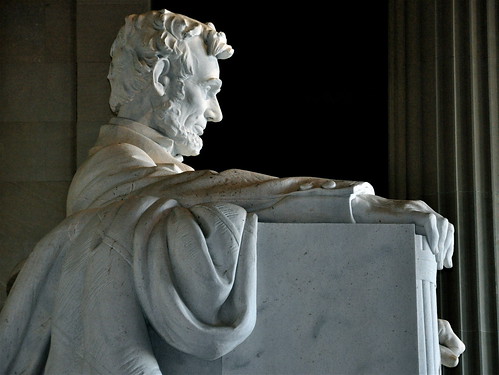
In a famous 1858 speech, soon-to-be president Abraham Lincoln was quoted as saying that "a house divided against itself cannot stand."  Even though President Lincoln was referencing the divide that had been caused by slavery, it can certainly be applied to our modern times.  But more than that, it wasn't Lincoln who came up with this phrase.  It was Jesus himself who said these words in Matthew 12:25 in response to the religious leaders of his day who insisted that his works were from Satan.

In addition, shortly before his crucifixion, Jesus prayed to God the Father for those of us that would believe in and follow Him.  This was his prayer:
"My prayer is not for them alone. I pray also for those who will believe in me through their message, that all of them may be one, Father, just as you are in me and I am in you. May they also be in us so that the world may believe that you have sent me. I have given them the glory that you gave me, that they may be one as we are one: I in them and you in me. May they be brought to complete unity to let the world know that you sent me and have loved them even as you have loved me. "Father, I want those you have given me to be with me where I am, and to see my glory, the glory you have given me because you loved me before the creation of the world. "Righteous Father, though the world does not know you, I know you, and they know that you have sent me. I have made you known to them, and will continue to make you known in order that the love you have for me may be in them and that I myself may be in them."
In accordance with Jesus's desire for his followers to be unified, I'd like to offer some practical suggestions on how we can grow towards unity:

1.  Spend time together. Martin Luther King said,
"Men often hate each other because they fear each other; they fear each other because they don't know each other; they don't know each other because they cannot communicate; they cannot communicate because they are separated."
Instead of listening to the media tell you how to feel about those that don't think like you, intentionally spend some time with those that hold different political beliefs or have a different cultural background.  Visit a different church and invite somebody new over for dinner. Spending time with someone's family over a meal (and they with yours) will go a long way.

2.  Seek to understand where they're coming from. So much of our political discussions these days are one-way shouting matches.  After learning that someone views politics differently than you, simply ask them, "That's an interesting perspective.  Why do you feel that way?  How did you come to hold that view?"  If you're a member of the Tea Party, it should concern you that some African Americans view that party as racist.  If you're a supporter of President Obama, it's important to understand that most disagreement with his policies is not because of his race.  In hearing another person's perspective, don't try to argue their points or try to prove where they're wrong.  You'll be amazed at how they might ask your opinion if you listen to them first.

3.  Look to find common ground.  Refuse to apply labels to one another.  It is all-too-easy to assume we know everything about someone because of their ethnicity or political affiliation.  Don't put people in a box just because you disagree with them over a single issue.  There are few things that are disappointing as being judged as something that you're not.  Look for that which you can agree on and build trust with one another.  Try to find good points that person makes and agree with them where you can.

4.  After building trust, respectfully disagree.  Even if you're able to form a friendship with someone, the issues that you disagree about aren't likely to go away.  To be friends with someone doesn't mean that you have to compromise your core convictions.  But if you've gotten to know them, you've listened well and you've sought to find common ground, the likelihood of having a healthy, productive conversation in which you disagree with one another without being disagreeable increases exponentially.  Political disagreements these days can so quickly devolve into arguments about petty, non-essential things.  Don't be like that.  

For those of us that are followers of Christ, we simply cannot allow our culture or our political affiliations to supersede our commitment to Jesus and his people.  We can be passionate about our views but we don't have to express them in a way that brings shame to Christ and distorts his purposes.  God's agenda is much bigger than any party platform and his plan is broader than what happens in our little country.  Yes, we can be bold in our convictions yet Christ-like in our humility.  And maybe, just maybe, if we begin to treat our brothers and sisters in Christ with more civility then maybe others might be attracted to the God we proclaim.

Saturday, August 28, 2010

How Will the Nation's Growing Diversity Affect College Students in a Decade?

Photo Credit: woodleywonderworks
As part of a leadership team that gives oversight to the direction of the U.S. Campus Ministry of Campus Crusade for Christ, I was involved in some meetings this past week in which we did some long-term strategic planning for the future of our ministry.

In order to meet the spiritual needs of an ever changing student culture, we cannot simply seek to respond to current realities. We have to be able to anticipate what will be coming down the road and pay attention to societal indicators of what students will be like in the next five or ten years.

One of the areas that I give particular attention to is the changing demographics in the United States and how that affects the life of college students and ministry to these students.  Within another decade, for most parts of the country, if a campus-based ministry is only effective in reaching those of European ancestry then that ministry will soon become obsolete.

We already know that close to four out of ten of the nation's college students are not white, but we have to look no further than the demographic makeup of the country's kindergarten students to see how rapidly ethnic minorities, particularly Hispanics and, to a lesser extent, Asian Americans, are increasing in number. 

USA Today covers this intriguing trend:
"The kindergarten class of 2010-11 is less white, less black, more Asian and much more Hispanic than in 2000, reflecting the nation's rapid racial and ethnic transformation.

The profile of the 4 million children starting kindergarten reveals the startling changes the USA has undergone the past decade and offers a glimpse of its future. In this year's class, for example, about one out of four 5-year-olds will be Hispanic. Most of today's kindergartners will graduate from high school in 2023.

More Hispanic children are likely in the next generation because the number of Hispanic girls entering childbearing years is up more than 30% this decade, says Kenneth Johnson, demographer at the University of New Hampshire's Carsey Institute. "It's only the beginning."

A USA TODAY analysis of the most recent government surveys shows:

• About 25% of 5-year-olds are Hispanic, a big jump from 19% in 2000. Hispanics of that age outnumber blacks almost 2 to 1.

• The percentage of white 5-year-olds fell from 59% in 2000 to about 53% today and the share of blacks from 15% to 13%.

"This is not just a big-city phenomenon," Johnson says. "The percentage of minority children is growing faster in the suburbs and in rural areas."
For those involved in education and in outreach to students, a growing appreciation, knowledge and experience with cultures other than one's own will be needed. For example, when Campus Crusade was founded in 1951 at UCLA, the campus had approximately 13,000 students and 98% were white. Today, there are 27,000 undergrads at UCLA and less than 1/3 are white. If estimates prove true, no one ethnic group within the U.S. will be in the majority after the next dozen years. If we want to be effective in reaching these students in the future, we need to make the necessary changes now. If we wait until then, it will be too late.

You can read the complete USA Today article here.

Wednesday, August 25, 2010

Gaining Hinds' Feet on High Places

Photo Credit: Noel Zia Lee
A couple of weeks ago my good friend, Charles Gilmer, led our Impact leadership team in a brief devotional from the Old Testament book of Habakuk.  We looked at Chapter 3 and focused especially on verse 19:
"The Lord God is my strength, and he will make my feet like hinds' feet, and he will make me to walk upon mine high places."
You may not be familiar with the actual scriptural reference but you may recognize the title from Hannah Hurnard's 1955 book, Hinds' Feet on High Places.  I was first introduced to Hurnard's classic through the Christian rock group, Jars of Clay, who based the title of their sophomore album, Much Afraid, on the main character from the book.

Even though I've owned a copy of Hinds' Feet for a number of years, I had never read it until last week.  The time my team spent examining the Habakuk passage motivated me enough to read the book on a recent flight and it ministered to me deeply.

Hinds' Feet on High Places is a fictional tale which describes the Christian life in allegory and tells the story of Much-Afraid, a lame and disfigured woman who desires to travel to the high places with the Chief Shepherd (who she tends sheep for), but lives in bondage to fear.  She lives in the Valley of Humiliation, along with her Fearing Relatives and dreads her arranged marriage to her cousin, Craven Fear.

Eventually, she expresses her wishes to the Shepherd to be given hinds' feet and travel to the high places with him.  He agrees to take her to the top of the mountain but he first chooses two traveling companions for her -- Suffering and Sorrow -- who will be by her side each step of the way.

On her journey to the high places, a number of her Fearing cousins -- like Pride and Self-Pity and Bitterness -- try to stop her from reaching the high places.  In addition to obstacles caused by her family, her travels to the high places take her along a difficult route as she has to spend time in a desert (where she discovers a flower called "Acceptance with Joy"), along the Sea of Loneliness, in the Forest of Danger and Tribulation, and mired in the Valley of Loss.

Though frightened much of the way, Much-Afraid chooses to believe the promises of the Shepherd and trust that the way he has chosen for her will lead to the high places.  At each step of completion along the way, she collects a stone of remembrance.  And along with each portion of the journey completed, she finds herself getting stronger and stronger.  After some time, she comes to an altar where she must lay her life down so that human love is removed from her heart and the Shepherd's love is allowed to blossom. 

As a result of her altar experience, she finds that the Shepherd has healed her and given her hinds' feet.  Even though she is now free to enjoy being in the Shepherd's presence and living in the high places away from her dreadful family, the Shepherd's love, which has now taken root in her heart, causes her to view her family differently.  She begins to understand the sadness in which they live and desires to travel down to the valley so that maybe she might point them to the Shepherd that has so changed her.

Much-Afraid learns that her traveling companions, Sorrow and Suffering, were needed for her to get to the high places.  They helped her build her strength and deal with the attacks of those seeking to do her harm.  In reaching the high places, she has learned to accept her trials with joy and to not hold bitterness towards her family.  Although she can also climb back to the high places at any time since she now has hinds' feet, she chooses to live in the valley with her family to show them a different way of life.

The Shepherd's love has so gripped her heart that she can't help but love those that were once like her.  Even more, the Shepherd gives Much-Afraid a new name and calls her "Grace and Glory" since "the old things have gone and the new has come." She, who was once dominated by fear, is now motivated by grace and the glory of the Shepherd.