Monday, September 06, 2010

The River of Life

Photo Credit: Al_HikesAZ
From Oswald Chambers's devotional, "My Utmost For His Highest":
"A river is victoriously persistent, overcoming all barriers. For a while it goes steadily on its course, but then comes to an obstacle. And for a while it is blocked, yet it soon makes a pathway around the obstacle. Or a river will drop out of sight for miles, only later to emerge again even broader and greater than ever. Do you see God using the lives of others, but an obstacle has come into your life and you do not seem to be of any use to God? Then keep paying attention to the Source, and God will either take you around the obstacle or remove it. The river of the Spirit of God overcomes all obstacles. Never focus your eyes on the obstacle or the difficulty. The obstacle will be a matter of total indifference to the river that will flow steadily through you if you will simply remember to stay focused on the Source. Never allow anything to come between you and Jesus Christ— not emotion nor experience— nothing must keep you from the one great sovereign Source."

Thursday, September 02, 2010

Mark Charles on Immigration Reform

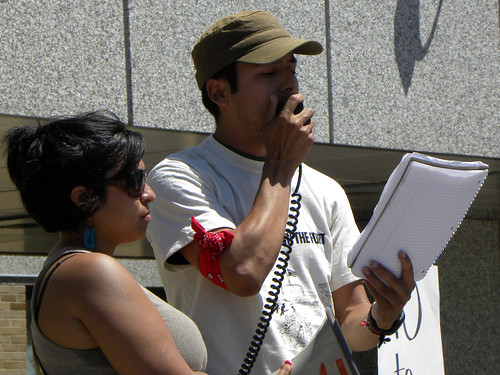
Photo Credit: Fibonacci Blue
My friend, Mark Charles, offers an intriguing perspective on the topic of immigration reform. Mark, who is a member of the Navajo tribe, has some compelling insights on the role that Native Americans can (and should) play in the national dialogue on comprehensive immigration reform.

Here's what he has to say:
"One of the buzz phrases I have heard in many social justice circles regarding the issue of immigration reform is “Comprehensive and Just Immigration Reform”. But I have taken a slight twist on that idea and have used it to advocate for our Native American communities by pointing out that “immigration reform will be neither comprehensive nor just unless it includes the voices and perspectives of the Native American peoples.

Right now I am not even advocating for any specific policy or stance. Instead I am merely observing that the voices of Native American are largely absent from this conversation. And so I am trying to speak to two separate audiences.

To our Native American communities I want to communicate that this is an important and historic dialogue for our country and our land and that we, as indigenous peoples, can offer a unique and invaluable perspective. We are the original inhabitants of this land and for the first time in centuries we have an opportunity to shape the dialogue regarding who should and should not be allowed to be here. So I want to encourage our people to step up and take our place in this conversation.

And to non-Native communities I am trying to point out the irony of trying to reform a policy on immigration without the indigenous inhabitants of the land participating in the conversation. I have witnessed and am convicted that merely our presence at the table where immigration reform is being discussed fundamentally effects and alters the conversation. This is because our Native American community is a visual reminder of our country’s unjust history regarding immigration policy, and that is even before we begin speaking and offering our distinct perspectives on the land and our relationship to it. And so I want our country and our leaders to pause, and notice that the Native American community is not actively a part of this conversation and then to intentionally invite us to the table.

I do not believe that either community can resolve this issue alone. And even together we are not going to get it perfect. But both voices are necessary if we want this reform to be more comprehensive and more just than our current policy is now."
To learn about some of Mark's upcoming speaking opportunities and to read more of his thoughts, you can visit his blog here.

Wednesday, September 01, 2010

Scot McKnight on Fundamentalism

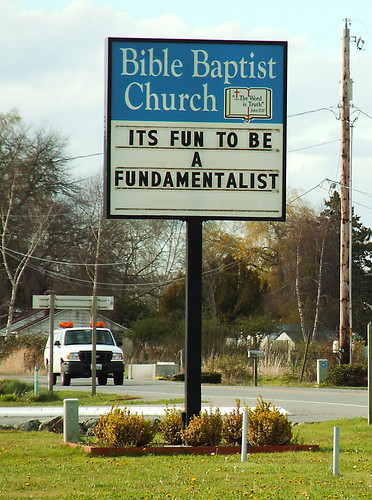
Photo Credit: Curtis Gregory Perry
Scot McKnight, who writes at the Jesus Creed blog, offers his take on fundamentalists and anti-fundamentalists:
"One the best things about growing up fundamentalist is that we absolutely knew we were on God’s side or perhaps it is better to say that God was on our side. Knowing God is on your side breeds confidence as well as other things … and I want to have a conversation today about those other things. I’m not concerned today about what a fundamentalist believes. Facts clearly show that fundamentalists and evangelicals and Catholics and orthodox Christians believe many of the same things. What I’ve tried a number of times to do is to think my way into why it is that many get upset with fundamentalists. What is it?

Zeal, too much of it. Relentless zeal. Imposing zeal. Absolute confidence in everything they think is important.

Here’s what I have observed: my experience shows that former and anti-fundamentalists can be just as fundamentalistic — zealous and absolute — about their anti-fundamentalism and new-found beliefs. In other words, they [are] absolutely confident liberalism is another form of fundamentalism.

These anti-fundamentalists (and anti-evangelicals) can be just as confident and cocky that they’ve got it all figured out. That they stand high above the rest in their perceptions of truth. They can be just as zealous for their new convictions, some of them petty. Once they saw all non-fundamentalists in danger of perdition, now they find everyone who doesn’t fight for the cause they believe in as hopeless or apathetic or non-Christian. I call this fundamentalist flop-flipping, from being a pro-fundamentalist fundamentalist to being an anti-fundamentalist fundamentalist.

There’s some good news here. I don’t believe we need to say “once a fundamentalist always a fundamentalist.” No, God mercifully grants us grace to find a different way, a third way, the way of grace and love that can hold firmly to one’s viewpoint and yet treat the other with respect and dignity."
You can read the rest of Scot's post here.