Wednesday, August 31, 2011

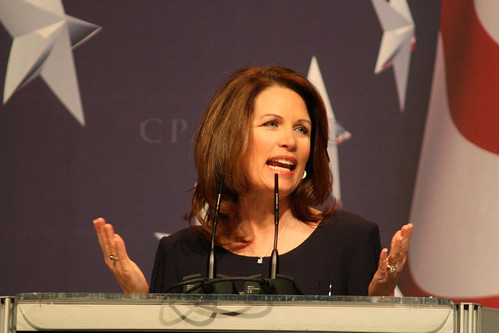
Christians & A Possible Woman President

Photo Credit: Gage Skidmore
Russell Moore comments on how Christians might view the possibility of a woman president:
"In 2008, Christians were faced with the real prospect of a woman president (Hillary Clinton) or vice president (Sarah Palin). Some (though very few) complementarian Christians wondered whether this could be right, while critics of traditionalist interpretations wondered how consistent it was for Christians to elect a woman to national office when they wouldn’t vote for her to serve as pastor of a local church.

...Unfortunately, American evangelicals have too often longed for a secular authority to serve as a spiritual leader, and political professionals have been all too willing to exploit this by teaching candidates to parrot evangelical-sounding phrases and “testimonies.” In such cases, political leaders become totem-like for evangelicals. An attack on a candidate who identifies with “us” is an attack on “us” or, worse, on Jesus. That’s unhealthy, regardless of whether the politician is male or female.

In the case of evangelical over-identification with political partisanship, though, there can be a subtle shifting in what it means to define a woman’s life, or a man’s, as a “success.” There is quite a bit of inconsistency in evangelical complementarians talking about a “gentle and quiet spirit” (1 Pet. 3) while cheering Ann Coulter’s latest sarcastic barbs.

I’m not all that worried about the gender of our political candidates, precisely because, relatively speaking, the political arena just isn’t all that important when compared to the church. What is important is the way our political passions often shift the way we view the mission of the church, and even what we expect in our homes."
To read Dr. Moore's complete post please click here.

Tuesday, August 30, 2011

How Children Can Thrive In Public Schools

Christian parents have a variety of options these days for educating their children. From homeschooling to private schools to charter schools to public schools, I am of the persuasion that there is no "one size fits all" approach to schooling options for Christian parents. We must each seek the Lord on what would be the best approach for our family and trust Him with how He leads us.

For our family, my wife and I have chosen to send our children to public schools. We have been pleased with their teachers, the education they have received and the environment in which they are able to receive their formal education. We know that for some families public schools may not be the best choice but for ours we believe it is.

Tim Challies has written a wonderful review of a new book, Going Public: Your Child Can Thrive in Public School by David & Kelli Pritchard with Dean Merrill. The purpose of the book is to help guide parents that have children in public schools on how to make their children's experience the best possible. Challies says this:
"What the Pritchards do is simple: they allow us into their home and family, telling us why they made the decision to public school and then showing us how they have gone about it. It’s not like they public school out of ignorance. To the contrary, they do what they do out of conviction that this is the way they can best raise their children in the fear and admonition of the Lord. That word “fear” is important to them. Following Proverbs, they say that the fear of the Lord “is the foundation on which all learning, all knowledge-gathering, all schooling should be built.” To do that, they focus on instructing their children from their earliest days in loving the Lord with all of their heart, soul, mind and strength; on learning unconditional obedience to their parents; and on attaining self-control. With these values being instilled in their children, they are ready to guide them through their education.

The most valuable lesson of all, at least in my view, is that public schooling is a family affair. The decision to place children in the public education system is a decision to have the whole family involved in this system. They say, “We should not think in terms of sending our child off by himself to ‘the mission field.’ We go there together. This is a family expedition. When we show up each August to enroll our kids for another school year, we are enrolling our family into the life of this institution. This is a joint venture.” This means that mom and dad are involved not just with the children, but with the school and teachers and leaders.

A second valuable lesson is that is the lesson that all parents are homeschoolers. The Pritchards make it clear that public schooling still calls for the parents to teach their children and to be involved in all that they learn. No good parent can abdicate all of the children’s education to other people.

There are many other lessons, of course. Some of them are broad in application while others are more specific. What I appreciate, though, is that all have come out of the testing ground of their own family. Through it all the Pritchards show their unshakeable belief in the sovereignty of God, their trust in his promises and their heartfelt desire to honor him in all things."
Having our children involved in the public school system can be a wonderful opportunity for Christian parents and families. But so, too, can other schooling options. Raising children in today's society is no easy task but I believe we can trust God to care for children no matter where they receive their formal education.

To read the complete post by Tim Challies please click here.
Monday, August 29, 2011

Embracing Change Or Defending The Status Quo?

Photo Credit: ginnerobot
Change is inevitable but that doesn't make it any easier when we are going through it. The organization that I worked for is in the process of a major change as we will be changing our name in early 2012. Though we feel like this change is needed in order to be more effective in our mission, there has been a vocal minority that has wanted to stick with the status quo.

Whether what we are doing is working or not is irrelevant to those that are fiercely committed to maintaining the status quo. They like things they way they are and want them to stay that way forever. But change sometimes is necessary and can be life-giving. There is typically a sense of loss that we experience when going through a major change but we still need to go through it in order to experience a better reality on the other side.

Seth Godin offers some pointed questions in considering if we might be a person that is too committed to the status quo:
  • Consider the cost of switching before you consider the benefits?
  • Highlight the pain to a few instead of the benefits for the many?
  • Exaggerate how good things are now in order to reduce your fear of change?
  • Undercut the credibility, authority or experience of people behind the change?
  • Grab onto the rare thing that could go wrong instead of amplifying the likely thing that will go right?
  • Focus on short-term costs instead of long-term benefits, because the short-term is more vivid for you?
  • Fight to retain benefits and status earned only through tenure and longevity?
  • Embrace an instinct to accept consistent ongoing costs instead of swallowing a one-time expense?
  • Slow implementation and decision making down instead of speeding it up?
  • Embrace sunk costs?
  • Imagine that your competition is going to be as afraid of change as you are? Even the competition that hasn't entered the market yet and has nothing to lose...
  • Emphasize emergency preparation and the expense of a chronic and degenerative condition?
Is there a change that you need to make in order to be more like the person that God wants you to be?  Is there something you need to do differently in an area of your leadership that will help you better realize the dreams God has placed on your heart?  Change for the sake of change is not necessarily the answer. But change in order to bring a better tomorrow is something to embrace.