Showing posts with label racial diversity. Show all posts

Thursday, June 15, 2017

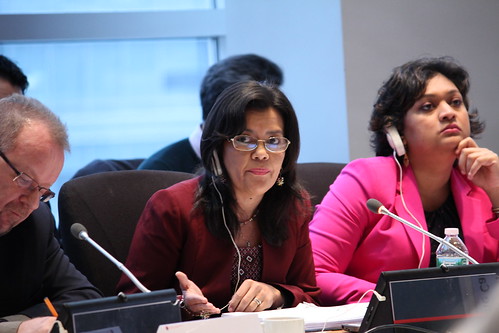
Diversifying Leadership in Non-Profit Organizations

Photo Credit:
Global Partnership for Education - GPE
One of the greatest challenges facing non-profit organizations that are seeking to be ethnically diverse is understanding that it is not just about having a diverse staff. Having more ethnic minorities in the top levels of leadership is critical for organizations that are seeking to become more diverse. But a multitude of barriers often exist in turning this vision into reality.

A recent study by the Building Movement Project-- Race to Lead: Confronting the Nonprofit Racial Leadership Gap -- illustrates that many attitudes about how a non-profit can increase its number of leaders of color might not be accurate.

Cyndi Suarez of NonProfit Quarterly comments on the findings:
"The report has a high-level message: “The results call into question the common assumption that to increase the diversity of nonprofit leaders, People of Color (POC) need more training. The findings point to a new narrative. To increase the number of People of Color leaders, the nonprofit sector needs to address the practices and biases of those governing nonprofit organizations.” 
In other words, while many investments in people of color leadership focus on training and other capacity building for people of color, the real need for capacity building is with the people who hire for executive leadership positions. 
Other studies have hinted at this. The Daring to Lead reports of 2006 and 2011 of more than 3,000 nonprofit leaders found that 82 percent of respondents were white. More recently, in BoardSource’s 2015 Leading with Intent report of non-profit boards, 89 percent percent of respondents identified as white. For over a decade now, survey reports consistently show that less than 20 percent of nonprofit executive leaders are people of color."
The report indicates that while it is important to intentionally focus on the development of leaders of color -- just as that is important for any emerging leader -- much greater emphasis needs to be placed on the development of non-profit leaders in the areas of cultural intelligence. In many non-profits there are structural and organizational barriers that limit the opportunity for ethnic minorities to advance in leadership.

Here are some of the specific conclusions drawn from the report:
› It’s NOT about Differences in Background or QualificationsPeople of color and white respondents have similar backgrounds in education, position, salary, and years working in the nonprofit sector. 
› It’s NOT about a Lack of AspirationsPeople of color aspire to be leaders more than white respondents. For those who do not aspire to leadership, most—across race—are looking to maintain work/personal life balance. But people of color who are not aspiring leaders are more likely to be looking for jobs outside of the nonprofit sector. 
› It’s NOT about Skills and PreparationMost aspiring leaders thought they had the qualities needed to be a good leader. When asked about the training they received, people of color and whites had few differences in the areas of financial skills, goal setting, articulating a vision, advocacy, and collaboration. People of color were more likely to see themselves as visionary and able to relate to their target population, but less ready to fund raise than whites. 
› It IS an Uneven Playing FieldThe majority of aspiring leaders feel prepared to take on an executive role. However, over a third reported they want more technical and management skills, with POC respondents identifying this need more often than whites. People of color were more likely than white respondents to see race/ethnicity as a barrier to their advancement. 
› It IS the Frustration of “Representing”All respondents have challenges, but people of color are significantly more frustrated by the stress of being called upon to represent a community. They are also more challenged by inadequate salaries, the need for role models, lack of social capital/networks, and the need for relationships with funding sources. 
› It’s NOT Personal, It IS the SystemRespondents across race squarely identify the lack of people of color in top leadership roles as a structural problem for the nonprofit sector. They believe that executive recruiters and boards could do more to diversify leadership. Whether due to bias or other factors, respondents of color were more likely than whites to agree it is harder for people of color to fund raise. They also were more likely than whites to see barriers to people of color advancing either because of smaller professional networks and/or the need for more training.
For leaders like myself that serve in predominately white non-profit organizations, it's especially important for us to realize that much of the work that needs to be done in becoming more diverse starts with us. If we as leaders have a myopic perspective on leadership and don't possess the understanding of cultural contexts other than our own, we will continue to create and perpetuate structures and systems that prevent some of the very things we say we want to see happen.

You can download the full report here.

Monday, April 07, 2014

Embracing Diversity Involves More Than Meets The Eye

Photo Credit: United Way of the Lower Mainland
Diversity is a bit of a buzzword these days but I wonder if most of us fully understand what diversity truly means. I fear that for many Christian organizations and churches, diversity simply means that a few people from cultures other than the majority culture are represented in a group.

But true diversity -- biblical diversity -- means much more than that.

For a Christian community to truly refer to itself as one that is Christ-honoring in its diversity, I believe that means that each person that is part of that community, no matter what their ethnic background or cultural experiences, is able to bring their FULL self in their pursuit of God's glory.

By Their Strange Fruit, a blog that I enjoy reading, offers some good thoughts on the topic of diversity. A highlight:
"Diversity cannot be the end goal, just like counting heads in pews isn't an end in itself. They're merely metrics. Diversity is simply a measure on the way to richer engagement and equality. Diversity is about quantity. As followers of Christ, we must also be interested in quality. 
We cannot pretend that getting many different faces in the room alters structural injustice. Going beyond diversity means setting aside our own agendas. It means asking how we may serve the priorities of those around us. We must share power, and set aside our privilege. Diversity itself does not assure these things. 
Too often white-dominated organizations (read: churches) seek people of color simply to validate their own structures and plans. They want diversity in their brochures and their stats. But they want 'just enough'--not too much. They don't want to be fundamentally changed from the dominant-culture organizations they are. If we believe our own way of running things should be the standard, then we are allowing our own hubris to get in the way of the Church that Jesus envisioned. 
We like diversity. We say we value it. We attend training events for it and put it in our mission statements. We like to pat ourselves on the back if we obtain a certain percentage. But have we served the purpose of creating a more just and equitable society? 
There is a place for diversity. It helps us be mindful of our group composition and avoid homogeneity. Sometimes we struggle even to attain nominal levels of diversity in our environments, so it remains one of our many goals toward racial justice. 
But diversity itself does nothing if unjust polices remain unchallenged. It is useless if voices remain silenced or certain opinions are not valued. It is pointless if we remain oblivious to crucial social issues outside of our cultural bubble. Diversity itself cannot change the deeply rooted inequalities at play in our society. For that, we need press further.
Embracing diversity involves much more than getting those of minority groups to adapt to and fit in with majority culture. Embracing diversity means to pursue a radical inclusiveness where justice is pursued, equality is valued and love reigns supreme.

To read the rest of the post from By Their Strange Fruit please click here.

Wednesday, October 08, 2008

Friendships Across Racial Lines

One of the blogs that I regularly read is God's Politics and there has been an interesting discussion on there about whether it is possible to build deep and meaningful friendships with someone of a different racial background than your own.

Although my immediate family is white (like me) and I attend a predominately white church, I live in a neighborhood in east Orlando that is heavily populated by Hispanics. In addition, I spend the better hours of my day working for an organization, The Impact Movement, that reaches out to those in the black community, with 90% of my co-workers being African American. So as one that is personally involved each day in building friendships with those of a different ethnicity, this topic has particular importance to me.

The discussion on God's Politics began with a critique of the New Monastic movement and with Bart Campolo's assertion that it is nearly impossible to build the kind of friendships with those of very different backgrounds than it is with those that have a similar life experience as our own. Here are some of his words:
"Bart’s point then and now is that, even as we reach out across racial and cultural barriers, we shouldn’t feel guilty about staying rooted in mostly homogeneous core communities, nor should we feel compelled to seek an essentially unnatural diversity within those core communities. While we shouldn’t automatically exclude different people from our inner circles, we shouldn’t feel obligated to change our group dynamics to suit them either. According to Bart, it is difficult, if not impossible, to build a core community that meets the deepest needs for intimacy and understanding of people with radically different backgrounds, and seeking to do so almost always results in painful divisions and burnout...Instead of feeling guilty about this limitation, Bart suggests we should accept it and resolve to use the strength we draw from our core communities for the important work of reaching out to build authentic cross-cultural relationships, wherein we learn from, teach, nurture, challenge, protect, mentor, and work together for justice with one another. Such relationships are not superficial—just not intimate.
The blog then posted two separate responses from other individuals here and here. To be fair to Campolo, he is someone that is practicing incarnational ministry as he lives among the people that he seeks to minister to in a disadvantaged part of Cincinnati. He is heavily involved in racial reconciliation and for that he has my respect. But I do have to disagree with him that truly intimate relationships cannot be formed across racial lines.

Because of the opportunities that I have in my everyday life to be around those of ethnicities other than my own, I've experienced firsthand the possibilities that can take place between those of seemingly incompatible backgrounds. My very simple definition of reconciliation between individuals is friendship. With those that are my true friends I am able to laugh, cry, share hopes and fears, argue, encourage and love.

If I can't really laugh with someone, then we're probably not that close. If they've never shared their hurts with me and I with them, we're probably not friends. If we've never been able to work through disagreement and conflict and come to a place of resolution, then any kind of friendship that we have will remain at the surface level.

In any relationship, conflict and hurt feelings are bound to arise, but it is how we respond to those conflicts that will determine the depth of our friendship. In cross-cultural friendships, those disagreements or misunderstandings can oftentimes be interpreted much differently than if those same things took place with a friend of our own culture. Many people that have intentionally sought to build a friendship with someone of a different race have not demonstrated the commitment to the relationship that is needed to sustain it. When times get tough, it's always easier to cut bait and run.

But therein lies the problem. Racial reconciliation involves trust, humility, servanthood and commitment. If I want to end a friendship with someone of another ethnicity the first time there's a problem, I was never that committed to the relationship in the first place. It is often in working through our conflict that we learn more about each other and come to greater places of understanding.

I know from personal experience that building relationships across racial lines is extremely hard work, but I know that it's worth it. I feel like I am a better person and a better Christian because of the close friendships I have with my friends that don't look like me. I have learned from them and they from me and we each have a greater picture of the unique ways that God has created us.