Monday, January 30, 2006

The Super Bowl and Detroit


The Super Bowl is less than a week away and the discussions on this American holiday being held in Motown are beginning to intensify. It's interesting to hear the image of Detroit that seems to be held in the national consciousness. The cold weather, the crime, the drugs, lack of anything to do, etc. are some of the common themes that are mentioned. I read this recent article by Jemele Hill, a Detroit native and a columnist for our local newspaper, The Orlando Sentinel, and thought her perspective was worth noting...

"Unfortunately, this column won't completely stop the jokes about how parts of Detroit look like a car bomb went off 20 minutes ago or that it gets so cold here, Dick Cheney's heart can chill on Eight Mile. Some free advice to you national columnists who are preparing to shred Detroit: Bombed-out building jokes are as old as Members Only jackets, so be more creative if you're going to insult us Detroiters.
The problem is that when it comes to Detroit, people can't separate the truth from the CNN footage. Yes, Detroit has lots of crime -- uh, doesn't every major city? -- but people act like as soon as you land in the Motor City, there are a couple of gunmen waiting for you at the end of the jetway. Oh, but nobody says a thing about Los Angeles, where if you wear magenta in the wrong neighborhood, you leave wearing Eau De Bullet.
"I've lived in Detroit all my life, and I've never been a victim of a crime," 60-year Detroit resident Janice Berman said. "I've never even seen a crime. Overall, people say Detroit is a bad place, but statistically I don't think it's worse than any other urban areas." Detroit has lived with a bull's-eye on its back for ages. Sadly, the main reason the national media are going to condemn Detroit during Super Bowl week is because it isn't in a warm-weather city.
So, sorry it's a Super Bowl that inconveniences journalists by forcing them to wear coats. We see the game for free, eat free on our respective companies, stay in hotels for free and go to parties for free, but bring a scarf? The nerve. Jacksonville is a warm-weather city, and all I heard from people after last year's Super Bowl was everything had to be done by boat, the city was too spread out and you couldn't find anything to eat past 9 p.m...
What makes the city special is that it has fulfilled a lot of dreams for people for years. African-Americans fled the South to Detroit looking for jobs, which they found in abundance at the city's auto plants. Greek immigrants came to Detroit seeking a better life, too. That's why there are 120,000 people of Greek descent in the Detroit area and a two-block stretch of terrific Greek restaurants along Monroe Street.
Arabs call Detroit home because here they're fully accepted. Detroit has the largest Arab population outside of the Middle East. "We've had to live by the factories," said Dan Keros, a third-generation Greek whose family owns American Coney Island, where you can find the best chili dogs in the city. "It's hard work, and it's inbred in us. We want to do our best, no matter what."
You might think of Detroit as the birthplace of violence, but without Detroit, there would be no Ben & Jerry's, Dr Pepper or automobiles. Ice cream, soda and Henry Ford all were born in Detroit. (The city also has the second-largest theater district in America next to New York, but I don't want to brag.) I know dogging Detroit has been an Olympic sport for years. Though the Olympics are every four years, and bad-mouthing Detroit happens nearly every day.
But riots happen everywhere (just ask Paris). Cold weather is a part of life, and certainly Florida's 75 consecutive 90-degree days have been known to cause a bit of discomfort. Detroit has problems, but any city with nearly a million people would have them, too. But if you still want to rip my city, I'd advise you to take heed of this warning from Keros: "You keep picking on us, and we'll get even better."
There must be something good about D-Town. We're the only northern city to host two Super Bowl in the past 25 years...

Monday, January 23, 2006

End of the Spear


The year was 1956 and several young missionaries from the United States left their homes, their families and the comfortable lives they knew so that they could take the gospel to a people group in Ecuador untouched by modern civilization. The missionaries were willing to place their very lives in harms way in order to tell the Waodani people about the love of Christ. Little did they know that it wasn't their lives, but their deaths that God would use to reach the Waodani.

Their martyrdom has motivated and inspired generations of missionaries for over 50 years (including my wife and I). After the deaths of Nate Saint, Jim Elliot, Pete Fleming, Ed McCully, and Roger Youderian, the proclamation of the gospel continued among the Waodani. And their tribe was transformed by the love of God...

A new movie about this well-known story, End of the Spear, just hit the movie theaters this past weekend (and was one of the top ten grossing films in America). I was able to see a screening of this movie this summer along with a number of other Campus Crusade staff. The story of Jim & Elisabeth Elliot motivated me tremendously while I was a college student as I wrestled with yielding my whole life to Christ. Their example of being willing to place their relationship before God and their very lives before Him challenges me even still today.

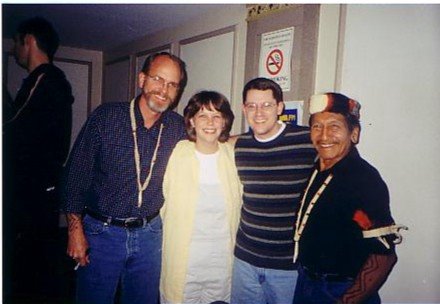
Lori and I had the privilege a few years ago of meeting two individuals who played significant roles in this story -- Steve Saint, the son of one of the murdered missionaries and Mincaye, one of the murders who eventually became a Christian. This is a picture of us with them. Their story challenges me because it causes me to consider my own commitment to Christ and the sacrifices that I'm willing to make for His sake. For most of us in America, the worst that will happen to us as Christians is that we may get mocked, teased or threatened. But for many believers around the world (even today), their lives are very much on the line because of their profession of faith in Christ.

By living in the the most affluent country in the world, we can easily get tied to our "stuff" and hold tightly to things that will pass away. Our top priority can quietly become our own safety and comfort, instead of God's glory. To call Jesus "Lord" means that we have yielded are lives completely to Him -- willing to go anywhere and do anything that He may ask of us. The example of Nate, Jim, Roger, Pete and Ed is one that we should all consider and examine our own hearts as we offer our lives as a sacrifice to the one who gave His life for us (Romans 12:1-2).

If you are not familiar with the whole story of the Ecuadorian missionaries who gave their lives so that others could live, I encourage you to check out End of the Spear while it is in the theaters. We vote with our dollars at the box office so that Hollywood can see that Christians want to see quality made films that tell our stories. You can read a review of this movie here.

Monday, January 09, 2006

Marriage is Great Equalizer for Blacks

Roland Warren, the president of the National Fatherhood Initiative, wrote the following column for USA Today recently. The column contains some disturbing statistics about the current state of the family in the African American community and the seemingly lack of importance that many have for having children within wedlock. Here is Warren's column:

"As a happily married man, I have been troubled by the oft-stated myth that the institution of wedlock has never been central to the African-American heritage. Unfortunately, this view has permeated the African-American community and society at large. Now, it may be single-handedly holding back blacks in their pursuit of social, economic and educational progress.

According to testimony given last fall to a Senate subcommittee by Ron Haskins of The Brookings Institution, from 1970 to 2001, the overall marriage rate declined 17% but 34% for blacks. The overall rate for out-of-wedlock births is 33% compared with 70% for blacks.

These disappointing trends are critical because research has shown that marriage provides significant benefits for men and women. Most important, children who are raised by their married, biological parents do better across every measure of economic, social, health and educational well-being than children raised in other family arrangements. In fact, when comparing families of similar socioeconomic status, these black children have similar outcomes as their white counterparts. Marriage is the great equalizer.

Alex Haley wrote Roots based on the belief that he was the descendant of an African slave named Kunta Kinte. Roots tells the story of his family, starting with Kunta's birth. Although some of Haley's research has been contested, Roots can teach us some valuable lessons, including one that few seem to discuss.

Kunta Kinte escaped his master several times only to be caught each time. But one thing finally caused him to change course: his marriage and the birth of his daughter. Kunta "jumped the broom" with Bell, the plantation's cook. The ritual was used to formalize the husband-wife bond, since slaves could not legally marry. Bell soon gave birth to their first daughter, named Kizzy, an African word for "stay put." Kunta decided that creating a legacy of hope for his family was more important than escape.

Kinte's dedication to his family is not unique. In 1890, 80% of black families with children were headed by married couples, according to sociologist Andrew Billingsley. That figure has dropped to 39%. In 1950, 64% of black males older than 15 were married compared with 68% of white males. By 1998, only 41% of black males were married. From 1950 to '98, the percentage of never-married black women doubled.

This divergence in black and white marriage rates is not the legacy that Kunta Kinte left for us. It is time for African-Americans to change the path that is holding our children and families back so that we can rediscover the "roots" of marriage."

I'm thankful to be a part of a ministry, The Impact Movement, that is helping to stem the tide of some of these alarming realities. It is my belief that the most important institution in the life of a child is that of the family. The media, school, friends, and church can all play significant roles in a child's development, but if their family and home life is a mess, it makes it overwhelmingly difficult for that child. On the other hand, if a child is raised in a home by a loving mother AND father, their chances of a successful life certainly increase.

I once read (and I apologize for not being able to quote the source) that if a child is born to a mother that is: 1) Unwed; 2) Under the age of 20; and 3) Without a high school diploma, then a life of poverty is almost assured for that child. While it is no doubt that single mothers are some of the most hard-working and resilient people you could meet, a child needs both a mommy and a daddy. Marriage is a sacred institution that needs to be uplifted and honored. Just imagine what our society would be like if everyone waited to have sex until they were married and then stayed in that marriage "in sickness and in health, 'til death do us part." Do you think things would look different? I do.