Tuesday, November 22, 2011

Combating Latina Negative Stereotypes on Television

Photo Credit: roniweb
Although Hispanics and Latinos now make up over 16% of the U.S. population, they remain woefully underrepresented on our country's most popular television shows. Hiispanics, especially when it comes to Latinas, featured on prime-time shows often fit narrow, stereotypical roles.

Melissa Castillo-Garsow addresses this issue:
"A 2008 study published in Human Communication Research found that Latinos continue to be hugely underrepresented on primetime television - at they time, they were 3.9% of the television population and 12.5% of the U.S.population. Latina characters were generally more likely to have the following traits than white or African-American characters: “addictively romantic”, “sensual”, “sexual” and “exotically dangerous.” 
These researchers also found that in comparison to characters of other races, Latinas were the “laziest”, “least intelligent” and most “verbally aggressive.” 
But what really bothers me about the roles of Adrian on “The Secret Life of the American Teenager,” Alice on “Hellcats” and Santana on “Glee,” is that these are shows marketed towards young audiences – teens and younger – who are still forming their impressions of the world. It makes me wonder who is watching, taking in and possibly acting on these stereotypes. 
Worst of all, Adrian, Alice and Santana are not stupid, or lazy, either. They are actually the cream of the crop – talented girls who excel at school, art or sports, representing real possibilities at diversifying the portrayals of Latina women in the media. Even so, they are still the sluts, still the manipulative characters that antagonize the likeable white character."
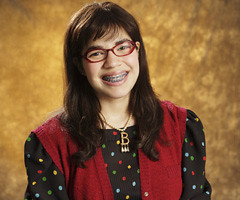
Castillo-Garsow points to America Ferrara's role in the ABC series, Ugly Betty, as an example of a stereotype breaking role for a young Latina. Ugly Betty, which left the air last year, helped to present a more complete and accurate portrayal of a Hispanic woman without overly sexualizing her or placing her in a domestic help role.

While it can be argued that some of these same stereotypes can be applied to white television characters, there is a plethora of personalities and characteristics, both positive and negative, that make up the complexity of majority culture television roles. The same can't necessarily be said for people of color. Television still has a ways to go in accurately representing the diversity that is in our country without playing to cliche and inherited stereotypes.

To read Ms. Castillo-Garsow's complete article on CNN.com please click here.

Sunday, November 20, 2011

How Are Broken People Different Than Proud People?

Photo Credit: ashley rose,
There are few books that I have found as personally convicting as Nancy Leigh DeMoss's book, Brokenness: The Heart God Revives. DeMoss goes into great detail about what makes a person's heart proud and how brokenness before God and others is a necessary reality in order to truly experience personal revival.

DeMoss recounts the story of the revival that happened among Campus Crusade staff out during our staff training in Colorado during the summer of 1995. I didn't join the staff of Campus Crusade until a few months after this happened so I wasn't there, but DeMoss shares about how God met all those present in a deep way. Sincere awakening happened among those present as many people confessed and repented of their sins against God and others.

Contrary to what some may think, those of us in vocational Christian ministries such as pastors and missionaries struggle with all the sins everybody else does and our lives are not perfect. We need the same Savior, Jesus, that everyone does and we, too, need to experience the gospel on a daily basis. DeMoss provides a list of the different characteristics of "Proud People vs. Broken People." There are over thirty areas on the list so I won't list them all, but here is a sampling:

  • Proud people focus on the failures of others; broken people are overwhelmed with a sense of their own spiritual need.
  • Proud people have a critical, fault-finding spirit and look at everyone else's faults with a microscope, but their own with a telescople; broken people are compassionate and can forgive much because they know how much they have been forgiven.
  • Proud people are self-righteous and look down on others; broken people esteem all others better than themselves.
  • Proud people have to prove that they are right; broken people are willing to yield the right to be right.
  • Proud people desire to be served; broken people are motivated to serve others.
  • Proud people desire self-advancement; broken people desire to promote others.
  • Proud people have a drive to be recognized and appreciated; broken people have a sense of their own unworthiness and are thrilled that God would use them at all.
  • Proud people feel confident in how much they know; broken people are humbled by how very much they have to learn.
  • Proud people are concerned about the consequences of their sin; broken people are grieved over the cause, the root of their sin.
  • Proud people compare themselves with others and feel worthy of honor; broken people compare themselves to the holiness of God and feel a desperate need for His mercy.
  • Proud people don't think they need revival, but that everyone else does; broken people continually sense their need for a fresh encounter with God and for a fresh filling of His Holy Spirit.
  • I don't know about you, but after reading this list, I'm confronted with the fact of how filled with pride I can be. I frequently blame others instead of accepting my own wrongs. I want to be served instead of serving others. I desire to be recognized above others. I justify my own sin while wanting the sins of others to be exposed. I can assume myself better than others but utterly fail the test when compared with God's standard. We all need to pray more consistently that God would root out the pride and sin in our hearts and replace it with brokenness, humility and grace.

    To order your own copy of this book you can find it here.

    Thursday, November 17, 2011

    The Danger of Becoming an Internet Busy-Body

    Photo Credit: Internet Society
    If you spend a similar amount of time online as I do, you are also at risk of becoming an "Internet Busy-Body." What is that you ask? Trisha Wilkerson writes about this type of person as one who spends an inordinate amount of time online with no real purpose -- just surfing the web, bumping around from site-to-site, wasting time by ingesting massive amounts of trivial news and random updates that don't necessarily serve any real purpose.

    Wilkerson says this:
    "When was the last time you found yourself going around from house to house being idle? Or, perhaps calling or texting too many friends in one day? Does boredom lure you in to busy-bodying? What do you gain by knowing more stuff? When does being curious distract your heart away from what God wants you to focus on? 
    The sin of the busy-body is often when desires are disappointed and we either demand or settle for the pleasure of knowing others’ business. Instead of being connected relationally to God and people, we slip into false intimacy and gather knowledge that doesn't grow us, but instead wastes time. Like greed or lust, busy-bodying is a thirst for more. We are saying to God that he doesn’t satisfy our hearts."
    This is a helpful reminder that although this is much that is positive about our ability to connect with another and learn new information on the Internet, there is also the temptation to flutter away significant amounts of time each week by wasting time online. We can all-too-easily trade the realities of our seemingly boring and mundane lives for the salacious and exciting news of celebrities and others we don't know.

    While there is certainly a place for entertainment and recreation, we should be concerned if we find ourselves spending more time living vicariously through the lives of others online than we do seeking to become better people ourselves who are growing closer to God and who connect in healthy relationships with others in real life.

    To read Trisha Wilkerson's complete post please click here.