Saturday, July 27, 2013

Which Countries Send The Most Christian Missionaries?

Photo Credit: TransformGrace
From Christianity Today:
"The Center for the Study of Global Christian (CSGC) at Gordon-Conwell Theological Seminary calculates that Christians sent out approximately 400,000 international missionaries in 2010. And nearly half of the world's top missionary-sending countries are now located in the global South. 
The CSGC reports that "of the ten countries sending the most missionaries in 2010, three were in the global South: Brazil, South Korea, and India." Other notable missionary senders included South Africa, the Philippines, Mexico, China, Colombia, and Nigeria. 
However, the United States still tops the chart by far in terms of total missionaries, sending 127,000 in 2010 compared to the 34,000 sent by No. 2-ranked Brazil. 
But examine the data differently—in terms of missionaries sent per million church members—and Palestine comes out on top at 3,401 sent, followed by Ireland, Malta, and Samoa (Interestingly, South Korea ranks No. 5 at 1,014 missionaries sent per million church members, a sign of the continued strength of its missions movement compared to the No. 9-ranked United States at 614 missionaries sent). 
The CSGC says U.S. dominance is part of a persistent missions imbalance: "The 10 countries that sent the most international missionaries in 2010 were home to 32 percent of the world's church members but sent almost 73 percent of all international missionaries." 
Meanwhile, most missionaries continue to go to mostly Christian nations. "The 'top nine' receiving countries were home to only 3.5% of the world's non-Christians but received more than 34% of all international missionaries," notes the CSGC. "All nine have Christian majorities, and they were home to over 34% of the world's Christians in 2010." 
By contrast, "The ten countries with the most non-Christians in 2010 were home to 73% of all non-Christians globally. Because many of them restrict or deny missionary access, however, they received only 9% of all international missionaries," notes the CSGC. The lion's share are in China, India, and Nigiera, where "large numbers of home missionaries also work among non-Christians." 
The country that received the most missionaries in 2010? The United States, with 32,400 sent from other nations."
To read the rest of the article please click here.

Wednesday, July 10, 2013

Has The Term 'Caucasian' Lost Its Usefulness?

Photo Credit: MyTudut
In a recent article, Shaila Dewan of The New York Times raises an intriguing question about whether the term 'Caucasian' is still a useful way to describe those of us of European descent. Personally, I'm not that fond of the term so I appreciate this dialogue.

Dewan offers the following background on the term:
"The use of Caucasian to mean white was popularized in the late 18th century by Johann Friedrich Blumenbach, a German anthropologist, who decreed that it encompassed Europeans and the inhabitants of a region reaching from the Obi River in Russia to the Ganges to the Caspian Sea, plus northern Africans. He chose it because the Caucasus was home to “the most beautiful race of men, I mean the Georgians,” and because among his collection of 245 human skulls, the Georgian one was his favorite wrote Nell Irvin Painter, a historian who explored the term’s origins in her book “The History of White People.” 
 In 1889, the editors of the original Oxford English Dictionary noted that the term Caucasian had been “practically discarded.” But they spoke too soon. Blumenbach’s authority had given the word a pseudoscientific sheen that preserved its appeal. Even now, the word gives discussions of race a weird technocratic gravitas, as when the police insist that you step out of your “vehicle” instead of your car. 
“If you want to show that you’re being dispassionate then you use the more scientific term Caucasian,” Ms. Painter said. 
Susan Glisson, who as the executive director of the William Winter Institute for Racial Reconciliation in Oxford, Miss., regularly witnesses Southerners sorting through their racial vocabulary, said she rarely hears “Caucasian.” “Most of the folks who work in this field know that it’s a completely ridiculous term to assign to whites,” she said. “I think it’s a term of last resort for people who are really uncomfortable talking about race. They use the term that’s going to make them be as distant from it as possible.” 
There is another reason to use it, said Jennifer L. Hochschild, a professor of government and African-American studies at Harvard. “The court, or some clever clerk, doesn’t really want to use the word white in part because roughly half of Hispanics consider themselves white.” She added, “White turns out to be a much more ambiguous term now than we used to think it was.”"
Many of us feel uncomfortable talking about issues of race and the continued use of the term Caucasian may just be one example. Due to our historical legacy within the United States, most of us have an uneasy relationship with the topic of racial identity. We're often not certain of how to refer to one another when describing the racial or ethnic background of others and, truth be told, many of us are unsure how to describe ourselves. We stumble over our words because we don't give much thought to it outside of situations when race is being expressly addressed.

Understanding the historical context for the terms we use when it comes to race is a good thing and provides a foundation for the language we use now and in the future.

To read the rest of the article please click here.

(h/t to TheRoot.com for the link.)

Sunday, June 30, 2013

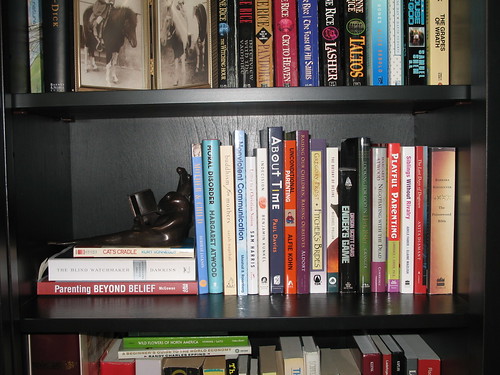
The Importance of Reading Authors Outside our Tribe

Photo Credit: theloushe
In a recent interview on The Gospel Coalition blog, Pastor Tullian Tchividjian offers his perspective on the importance of reading and the importance of exposing yourself to works you may not already agree with. He says the following:
"My nightstand is a mess—the biggest eyesore in our bedroom (according to my wife). I have about 30 books piled up on top of each other. I'm constantly reading, and I'm always reading more than one book at a time. I have everything from books I've been asked to endorse to books I'm consulting for my current sermon series to books I'm reading for fun. 
I'm also a curious reader, which means I'm always reading books by people just to find out how they write and what they say about certain things—which means I'm not simply reading books by people within my theological tradition. One of my concerns about some who would consider themselves "reformed" is that they only read books by other "reformed" people. This, in my opinion, is a big mistake. And when some do read books outside their own theological tradition, they only do so with an eye to critique instead of an eye to learn. At least this was my mistake for far too many years. I graduated from a well-known reformed seminary (and am unbelievably grateful for the education I received there), and I never heard of any of the books, theologians, or scholars I list below (except one). I have, therefore, greatly varied my reading over the past five years or so and am reading many more books by writers, thinkers, and scholars outside of my theological  tradition. Seven years ago I heard Tim Keller say, "When you read one thinker, you become a clone. Two thinkers, you become confused. Ten thinkers, you begin developing your own voice. Two or three hundred thinkers, you become wise."
The easy thing for avid readers is to simply read those that we know we already agree with or enjoy. Although this can help cement the beliefs we hold, we rarely will be challenged in our thinking. This can, at times, lead to the presumption that most others think as we do. I think it's also good for us to expose ourselves to the writings of those that are unfamiliar to us or not of "our tribe." This can help us in seeing the holes in some of our thinking, shore up that which we know to be true and cause us to look at the world differently.

As a Christian, I seek to make the Bible the guide for all other reading that I do. I try to read the Bible more than anything else and attempt to use God's Word as the lens through which I read other writings. Although I don't end up agreeing with the assertions of every author I read, there is much to be learned from those outside of our denominational affiliations or our cultural background.

For example, there are some blogs that I read in order to learn about the culture in which we live even though I don't agree with the perspective that is taken most of the time. However, I'm able to gain some insight into the thinking that is common in today's society and this helps me in relating to others from backgrounds that are different than mine.

Reading a broad range of authors can help us learn what it is that we believe and what makes us unique from others. It can help enhance our view of the world as we learn from those that have had different experiences and take the opportunity to see things through the eyes of another. I think I'm a different person than I was twenty years ago, due in no small part because of the broad range of people that I have read. And, hopefully, I'll continue to change for the better over the next twenty years.

For a list of the 25 books that have greatly influenced my life, please see this previous post.