Showing posts with label multiethnicity. Show all posts

Sunday, May 21, 2017

Weekly Web Roundup (5/20/17)

Photo Credit: sheldon0531
Here is a collection of items from around the web that caught my attention this past week:

A conversation with Andy Crouch about family and technology from Russell Moore

In this episode of the Signposts podcast, Dr. Moore offers an enlightening conversation with author Andy Crouch. They discuss how parents can create healthy boundaries with their children regarding technology use.

Standing Rock changed how I see America by W. Kamau Bell (CNN)
"I can't imagine what it must be like to be one of the indigenous people of the United States of America. I can't imagine watching the news every day -- as people debate whose country this is and who should be in charge of it and how to make it great again -- and hardly ever see your people brought into the discussion. As a black person in this country, I am always frustrated by the lack of attention my people's issues get. But at least the news and politicians are talking about not talking about our issues. Native issues are basically ignored."
Jesus, the Frybread of Life by Deborah Pardo-Kaplan (Christianity Today)

Here's a great profile of the work of InterVarsity Christian Fellowship (IV) as it pertains to Native American college students. Cru's Native ministry -- Nations -- partners closely with IV and is mentioned in the article.

My Family’s Slave by Alex Tizon (The Atlantic)
"She was 18 years old when my grandfather gave her to my mother as a gift, and when my family moved to the United States, we brought her with us. No other word but slave encompassed the life she lived. Her days began before everyone else woke and ended after we went to bed. She prepared three meals a day, cleaned the house, waited on my parents, and took care of my four siblings and me. My parents never paid her, and they scolded her constantly. She wasn’t kept in leg irons, but she might as well have been. So many nights, on my way to the bathroom, I’d spot her sleeping in a corner, slumped against a mound of laundry, her fingers clutching a garment she was in the middle of folding."
Why People Fight Online (The Barna Group)
"“Our most fraught conversations seem to have moved from the dinner table to the screen,” says Roxanne Stone, editor in chief at Barna Group. “However there are very few rules of etiquette in place for the internet yet. Where once family members could put a stop to an argument with a cry of ‘no religion or politics at the table!’ the digital world does everything to encourage such debates. And, of course, it’s a lot easier to be an anonymous jerk to a stranger than it is to yell at your mom. “Yet, there is a real person on the other end of that comment and online bullying has proven to be a truly destructive force,” says Stone. “The number of teen suicides attributed to it is but one extreme and horrifying example of its potency. Our level of civility and straight-up kindness should not be dependent on whether we are physically with a person or whether we know them. It’s easy to disembody the messages we read online and imagine our own posts are simply going out into an indifferent void. But real people are really hurt by the things said about and against them online."
The Blessing of Conflict by Chanequa Walker-Barnes (Collegeville Institute)
"The therapeutic definition of conflict is simple: a difference of opinion between two or more people. In this sense, conflict was not inherently bad; in fact, it was evidence of the family’s capacity to allow and cope with self-differentiation among its members. In a healthy family system, members have both a strong sense of group cohesion as well as clearly developed individual identities. The way in which families managed the dinner exercise told us something about that. On this task, a healthy family was one in which people offered different ideas about what they wanted, and then they worked through it to agree upon a menu that accommodated some, although not necessarily all, of those differences."
This Is All of Us - Mandy, Milo, Sterling and Chrissy Surprise Fans

NBC's "This is Us" became one of my favorite shows this past year. This video shows the stars of the show unexpectedly surprising fans of the show.


Saturday, April 29, 2017

Weekly Web Roundup (4/29/17)

Photo Credit:
US Department of Education
Here is a collection of items from around the web that caught my attention the past couple of weeks:

Sorry Weber, Durkheim, and Marx: Educated Evangelicals Are More Religious by Sarah Eekhoff Zylstra (Christianity Today)
"Evangelicals who graduated from college are more likely than those who didn’t enroll to attend religious services at least weekly (68% vs. 55%), to pray daily (83% vs. 77%), and to believe in God with absolute certainty (90% vs. 87%). They’re also more likely to say religion is very important to them (81% vs. 79%). Those numbers aren’t a fluke; when Pew broke the categories down further, the trend continued. Evangelicals who earned a graduate degree after college are the most committed to their faith; those who dropped out of high school are the least committed."
The Missing Piece in American International Missions by Courtlandt Perkins (Reformed African American Network)
"In many places, ethnicity and faith are deeply connected to a people group’s identity, so to only see people with white skin representing Christ speaks volumes about what Christians look like. The human heart naturally doesn’t want to receive Christ due to depravity, but what if the dark skin of a missionary helps them be received into an African village, simply because they look familiar? The unreached will physically see that Jesus changes the lives of people who look like them. African American missionaries could inspire a generation of African missionaries to receive Christ, and take His message to places AA’s could never go. In the same way, sending Hispanic-American missionaries to Latin American countries, we could help deconstruct the notions of white superiority, and point to the reality that white Christians do not have the copyright of international missions. It is obvious the issues run deeper than just numbers. The reality is often rooted in inherit racial bias and historical discrimination. But my friend’s words resound deeply with me: “Diversity is a powerful (and much needed) tool for witness.”"
6 Tech Habits Changing the American Home (Barna Group)
"Technology is literally everywhere in our homes—not only the devices in our pockets but the invisible electromagnetic waves that flood our homes,” writes Andy Crouch in his new book The Tech-Wise Family, written in partnership with original Barna research. “This change has come about overnight, in the blink of an eye in terms of human history and culture. When previous generations confronted the perplexing challenges of parenting and family life, they could fall back on wisdom, or at least old wives’ tales, that had been handed down for generations. But the pace of technological change has surpassed anyone’s capacity to develop enough wisdom to handle it. We are stuffing our lives with technology’s new promises, with no clear sense of whether technology will help us keep the promises we’ve already made."
The Legitimacy of Ethnic Churches in Multi-Ethnic Contexts by Andrew Ong (Reformed Margins)
"While pursuing a church demographic that proportionally matches the community’s might be a helpful and wise benchmark for certain churches, to impose any particular vision of unity and diversity upon a local church strikes me as mechanistic. This is especially true since the automobile has fundamentally altered our conception of communities’ bounds. How many of us worship at the closest Christian church to our home? Binding local churches to the norm of multi-ethnicity is mechanistic if our conception of church unity is absolutely bound by spatial-location. Is a church less faithful if it’s attended by more people who live ten minutes away by car than people who live ten minutes away by foot? Didn’t Jesus just say that his sheep would hear his voice?"
One Teenager's (Supremely Brilliant) Perspective on Social Media (Scott Sauls)
"When I finally spent a week “unplugging” from my phone, I realized that the withdrawals I experienced from disengaging from the app were a sign of the control it had over me. This control scared me and made me angry because I had willingly put myself in an unnecessary position to compare my insides to others’ outsides, to be controlled by my appearance and people’s opinions, and to hurt others and myself with my comments, posts, or digital footprint. This unnerved me because it was a dangerous trap that had been disguised by an attractive, socially acceptable, and necessary staple of popularity. After I deleted my social media accounts, I began to notice how other teenagers my age were trapped in the same digital world that I was. I wanted to understand why this was happening. What exactly are we as a society risking with the constant attachment to our screens?"
Why a racially insensitive photo of Southern Baptist seminary professors matters by Jemar Tisby (The Washington Post)
"But the biggest problem doesn’t show up in the picture. The presence of any person of color would have reduced the chances of this photo ever happening. But a photo like this evolves in an environment that lacks meaningful interaction with people from other cultures, especially on the leadership level. The seminary’s website appears to picture all white men in an administration and an entire preaching faculty. Even if a school has diversity in the student body, if the decision-makers all come from a similar racial and cultural background, then they will remain oblivious to their own racial blind spots."
The Guide to Being a Detroit Sports Fan by Dan Holmes (Detroit Athletic Blog)
"What does it mean to be a Detroit sports fan? What should we all know? What do we need to know? Not everyone has the answers to these questions, so I wrote them all down in one place. Enjoy."

Wednesday, March 29, 2017

13 Books to Help You Live in Multi-Ethnic Community

It has been over twenty years since God started me on a journey of learning as I began a lifestyle of crossing cultures within my ministry and daily life. Initially much of this was directly related to my role as a campus missionary with Cru. But, over time, my appreciation for those from different cultural backgrounds has grown to the degree where I have a high value of regularly interacting with those whose cultural values are different than my own.  

Part of this journey has also involved learning about what it means to be part of multi-cultural teams and to live in multi-ethnic community. I have had the privilege of being on multi-ethnic teams where I have been both in the minority and in the majority. I have also enjoyed the opportunity to be led -- both spiritually and vocationally -- by those that are of a different ethnic background than me.

In addition to the many ways I've benefited personally and learned from friends and colleagues over these past two decades, I have also found a number of books that have helped put words to the feelings I have experienced. These authors have assisted me in the process of learning more about myself and others and helped in answering questions that had me perplexed.

Here are 13 books that I recommend to guide you in learning what it means to live in multi-ethnic, Christian community. I've read each of these books, except for a few. In those cases, I trust the authors and the content enough to recommend them to you. Here they are (in no particular order):

1. Many Colors: Cultural Intelligence for a Changing Church by Soong-Chan Rah
"Soong-Chan Rah's book is intended to equip evangelicals for ministry and outreach in our changing nation. Borrowing from the business concept of "cultural intelligence," he explores how God's people can become more multiculturally adept. From discussions about cultural and racial histories, to reviews of case-study churches and Christian groups that are succeeding in bridging ethnic divides, Rah provides a practical and hopeful guidebook for Christians wanting to minister more effectively in diverse settings."

2. The Wolf Shall Dwell with the Lamb: A Spirtuality for Leadership in a Multi-Cultural Community by Eric Law
"This groundbreaking work explores how certain cultures consciously and unconsciously dominate in multicultural situations and what can be done about it."


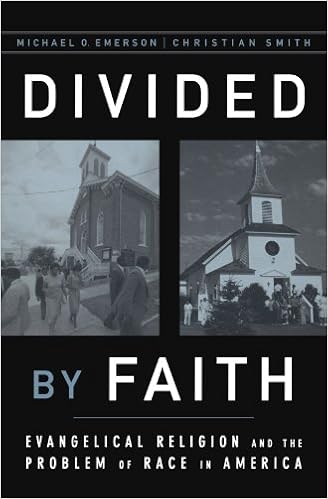
3. Divided by Faith: Evangelical Religion and the Problem of Race in America by Michael O. Emerson & Christian Smith
"Through a nationwide telephone survey of 2,000 people and an additional 200 face-to-face interviews, Michael O. Emerson and Christian Smith probed the grassroots of white evangelical America. They found that despite recent efforts by the movement's leaders to address the problem of racial discrimination, evangelicals themselves seem to be preserving America's racial chasm. In fact, most white evangelicals see no systematic discrimination against blacks. But the authors contend that it is not active racism that prevents evangelicals from recognizing ongoing problems in American society. Instead, it is the evangelical movement's emphasis on individualism, free will, and personal relationships that makes invisible the pervasive injustice that perpetuates racial inequality."

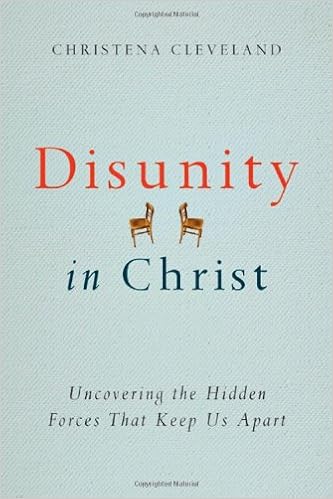
4. Disunity in Christ: Uncovering the Hidden Forces that Keep Us Apart by Christena Cleveland
"Despite Jesus' prayer that all Christians "be one," divisions have been epidemic in the body of Christ from the beginning to the present. We cluster in theological groups, gender groups, age groups, ethnic groups, educational and economic groups. We criticize freely those who disagree with us, don't look like us, don't act like us and don't even like what we like. Though we may think we know why this happens, we probably don't. In this eye-opening book, learn the hidden reasons behind conflict and divisions."

5. Living in Color: Embracing God's Passion for Ethnic Diversity by Randy Woodley
"Though our Christian experience is often blandly monochromatic, God intends for us to live in dynamic, multihued communities that embody his vibrant creativity. Randy Woodley, a Keetowah Cherokee, casts a biblical, multiethnic vision for people of every nation, tribe and tongue. He carefully unpacks how Christians should think about racial and cultural identity, demonstrating that ethnically diverse communities have always been God's intent for his people. Woodley gives practical insights for how we can relate to one another with sensitivity, contextualize the gospel, combat the subtleties of racism, and honor one another's unique contributions to church and society."

6. Cross-Cultural Servanthood: Serving the World in Christlike Humility by Duane Elmer
"Duane Elmer asked people around the world how they felt about Western missionaries. The response? "Missionaries could be more effective if they did not think they were better than us." The last thing we want to do in cross-cultural ministry is to offend people in other cultures. Unfortunately, all too often and even though we don't mean it, our actions communicate superiority, paternalism, imperialism and arrogance. Our best intentions become unintentional insults. How can we minister in ways that are received as true Christlike service? Cross-cultural specialist Duane Elmer gives Christians practical advice for serving other cultures with sensitivity and humility."

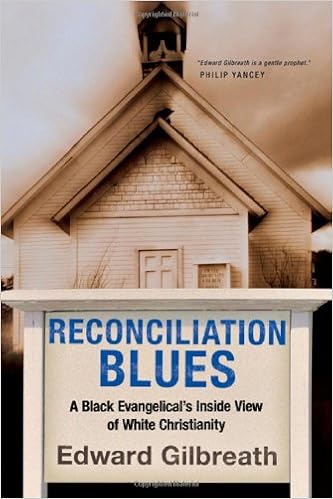
7. Reconciliation Blues: A Black Evangelical's Inside View of White Christianity by Edward Gilbreath
"What is the state of racial reconciliation in evangelical churches today? Are we truly united? In Reconciliation Blues journalist Edward Gilbreath gives an insightful, honest picture of both the history and the present state of racial reconciliation in evangelical churches. In his thoughtful overview he looks at a wide range of figures, such as Howard O. Jones, Tom Skinner, Dr. Martin Luther King Jr., Jesse Jackson and John Perkins. Charting progress as well as setbacks, his words offer encouragement for black evangelicals feeling alone, clarity for white evangelicals who want to understand more deeply, and fresh vision for all who want to move forward toward Christ's prayer "that all of them may be one.""

8. Right Color, Wrong Culture: The Type of Leader Your Organization Needs to Become Multiethnic by Bryan Loritts
"Increasingly, leaders recognize the benefit of multi-ethnic organizations and are compelled to hire diverse individuals who will help them reflect a new America. [Loritts] brings a challenge to leaders in this fable of self-discovery and change, as he explores the central, critical problem leaders often encounter when transitioning their church, business, or organization to reflect a multi-ethnic reality: finding a leader who is willing to immerse themselves in the environments and lives of people who are different from them."

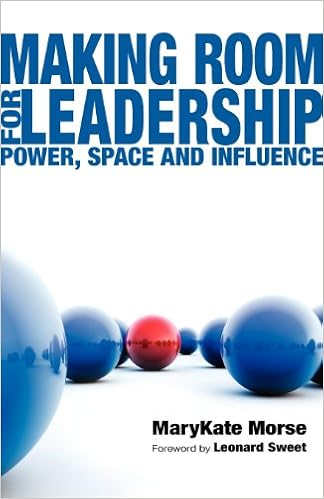
9. Making Room for Leadership: Power, Space and Influence by MaryKate Morse
"You don't just lead with your voice and your decisions. You lead with your body. The way you take up space in a room, the way you use or don't use your body in group settings, influences others. And all of us hold power to lead in our bodies. Yet, pastor and spiritual director MaryKate Morse contends, most of us are unaware of the ways we do or can use our bodies to influence others. Some of us cower in the corner, trying to hide. Others try to speak but are never heard. Still others are the focal point as soon as they walk in a room. What makes the difference? And how can we learn to lead in our own individual way with confidence?"

10. Bridging the Diversity Gap: Leading Toward God's Multi-Ethnic Kingdom by Alvin Sanders
"In a diverse, divided world, pastors and church leaders are faced with the question of how to lead across ethnic lines to bring healing and unity to the body of Christ. How can the church more accurately reflect the vision of God's kingdom, gathering together every tribe and nation? It all begins with leaders whose minds and hearts have been transformed by the gospel. Author Alvin Sanders believes the church is facing a chairos moment—the right time—to address the issue of ethnic division and tension within the church. Through this book, he offers a how-to resource for Christian leaders to lead their organizations in a majority-minority, multi-ethnic America."

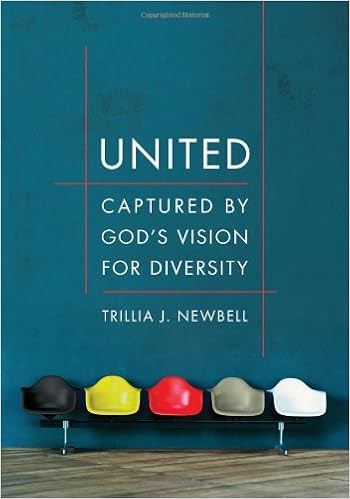
11. United: Captured by God's Vision for Diversity by Trillia J. Newbell
"On the Last Day every tongue and tribe will be represented in the glorious chorus praising God with one voice. Yet today our churches remain segregated. Can we reflect the beauty of the last day this day? United will inspire, challenge, and encourage readers to pursue the joys of diversity through stories of the author's own journey and a theology of diversity lived out. It’s time to capture a glimpse of God’s magnificent creativity. In the pages of United, Trillia Newbell reveals the deeply moving, transforming power of knowing—really knowing—someone who is equal yet unique. As we learn to identify in Christ rather than in our commonalities, we begin to experience the depth and power of gospel unity."

12. Breaking Down Walls: A Model for Reconciliation in an Age of Racial Strife by Raleigh Washington & Glen Kehrein
This is a classic resource for Christians from different cultural backgrounds that are seeking to understand one another. Breaking Down Walls suggest several principles on how we can be reconciled with one another for God's glory. This was one of the first books that I ever read on this subject.


13. Red, Brown, Yellow, Black, White—Who's More Precious In God's Sight?: A call for diversity in Christian missions and ministry by Leroy Barber & Velma Maia Thomas
"[This book] highlights the historic patterns that have created racial discrepancies within missions. With a no-blame attitude, powerful personal narratives from a dozen other black, Hispanic, Asian, Native American and white Christians, interactive histories of missions, and the writings of MLK and Howard Thurman (the entire "Letter From Birmingham Jail" and Howard Thurman's motivational speech "Sound of the Genuine"), Barber addresses this tough issue in a way that will inspire and motivate readers of all races toward change."

I hope you find these books helpful for you in your own journey toward multi-ethnic community and I'd love to hear from you any suggestions about other books you have found beneficial as well.

Saturday, March 11, 2017

Weekly Web Roundup (3/11/17)

Photo Credit: LaMenta3
Here is a collection of items from around the web that caught my attention the past couple of weeks:

Five Reasons Why Pastors Are Getting Fired Because Of Their Social Media Posts by Thom Rainer
"By the way, churches will not always tell the pastor the specific reason for the firing. But, once we begin to infuriate our church members with our posts, many will find a myriad of reasons to give us the boot. I recently recommended a pastor to another church. I think very highly of him. Indeed, the search committee chairman seemed genuinely enthused when I recommended him. He contacted me a couple of weeks later with this comment: “We can’t consider him. He’s just too snarky and sarcastic on social media.” Of course, this pastor was not fired. But he never had a chance to be considered by another church."
Bonhoeffer’s Black Jesus: A Reflection on This Last Day of Black History Month by David Fitch (Missio Alliance)
"As he spent time there with African American people, working alongside them in their struggles, he was able to see a new Jesus, a Jesus not entombed by German nationalism, and, he went back to Germany a different man. He resisted the sinister forces of the Deutschen Christen movement who had amalgamated their Christianity with the German nationalist Aryan agenda of Hitler. Bonhoeffer became a singular force in resisting the powers of evil and injustice of the Nazism infested culture. Anytime I read about Bonhoeffer’s life I am immensely challenged. But this book, gives us insight into how to decontextualize ourselves from our own culture-bound Christianity, being with people of another culture (even those within our own country), and how that becomes the means of transforming our own church. This singular truth is why I am so committed to the study of contextual theology."
Conversations With College Students on a Politically Divided Campus by Emily Deruy (The Atlantic)
"On Tuesdays, the group arranges a few desks in an unlocked classroom in a circle, sits down, and talks. It can get tense, but no one yells, no one storms out, and everyone has a chance to explain why they feel the way they do. Afterward, they sometimes go for drinks and late-night snacks at the Applebee’s nearby [the Central Michigan University campus]. The society is one example of how, at a time when Washington and much of the rest of the country is gripped by political polarization that can make substantive conversations about policy differences difficult, college students on politically divided campuses, who are part of a generation many older Americans expect to be apathetic, have found a way to have those conversations in a productive way."
Leading Someone Who Dislikes You by Dan Reiland
"I’m confident you love the people you lead, but that doesn’t mean you show it and they know it. You may show you love them, but not in a way they receive it. The pace of ministry leadership is often fast. That reality combined with the pressure to get things done can squeeze out the foundation of all good relationships, which is love. And for leaders, loving means giving more than you take. If you are not careful, the pressure to produce will cause you to take more than you give. When you are yourself, and give more than you take, people will trust you. If they trust you, they will follow you. I can almost guarantee that the individual who doesn’t like you, doesn’t feel loved by you. And if that is the case, they will never let you lead them."
A UPenn psychologist says there's one trait more important to success than IQ or talent by Shana Lebowitz (Business Insider)
"For instance, she [Angela Duckworth] conducted a study that found "grittier" kids — those who studied more and competed in more spelling bees — were more likely to perform well in the Scripps National Spelling Bee. To be sure, verbal intelligence also mattered, but verbally talented spellers didn't necessarily study or practice more. Similarly, Duckworth found that West Point cadets who scored higher on the grit scale were more likely to stick it out through "Beast Barracks," an intensive seven-week training program. (The grit scale includes items like "I don't give up easily" and "I have overcome setbacks to conquer an important challenge.") Grit was a better predictor of who would stay through Beast than things like athletic ability or SAT scores. As Duckworth writes: "Our potential is one thing. What we do with it is quite another."
Christian singer Steven Curtis Chapman: ‘Trust God’ through tragedy by Adelle M. Banks (Religion News Service)

Here's a nice profile on my favorite musical artist -- Steven Curtis Chapman -- and the story behind his new book, Between Heaven and the Real World.

Stewarding a Multiethnic Campus by Sarah Eekhoff Zylstra (The Gospel Coalition)
"Campus Outreach was started by the predominately white Briarwood Presbyterian Church on the campus of Samford University, a Baptist affiliate that resisted integration until the American Bar Association pressured Samford’s Cumberland School of Law to admit the university’s first black student in 1967. The rest of the university followed; however, in a city nearly three-quarters African American, the school is still more than 80 percent white. So it’s no wonder that in the beginning, Campus Outreach ministered primarily to white students. 
But within the last decade, the ministry has undergone a remarkable change. The Campus Outreach franchise in the Dallas/Fort Worth area is about half black. So is ministry at the University of Memphis. And across the 87 American campuses, the share of black students has reached 13 percent, which matches the overall percentage of black students at schools where Campus Outreach is working. Moving to a multiethnic Campus Outreach hasn’t been an easy process; to those working at Campus Outreach, it also seems frustratingly slow. But what they’re doing—shifting gears mentally to steward students of every shade—is proving enormously effective."
Why ‘This Is Us’ Makes Us Cry by John Jurgensen (The Wall Street Journal)

Here's a piece explaining why NBC's new hit show, This is Us, has connected on an emotional level with so many viewers.

BBC Expert's Kids Interrupt Important Live Interview

This is simply too funny not to share. I'm sure anyone with young children that attempts to work from home can relate.


Saturday, February 25, 2017

Weekly Web Roundup (2/25/17)

Photo Credit: Marco Nürnberger
Here is a collection of items from around the web that caught my attention this past week:

In the time you spend on social media each year, you could read 200 books by Charles Chu (Quartz)
"Here’s the simple truth behind reading a lot of books: It’s not that hard. We have all the time we need. The scary part—the part we all ignore—is that we are too addicted, too weak, and too distracted to do what we all know is important… All it takes to start reading a lot more is to take “empty time” spent Twitter-stalking celebrities or watching Desperate Housewives and convert some of it to reading time. The theory is simple. It’s the execution that’s hard."
Why Your Denomination Is Segregated (Christianity Today)
"Not all denominations’ equally reached enslaved people with their message, says Eric Washington, a history professor at Calvin College. The “stodgy” and “erudite” tradition of Anglicanism didn’t resonate as broadly—although former Methodist Absalom Jones was ordained as the first African American Episcopalian priest by the end of the 18th century. In contrast, many African slaves were drawn to Methodism’s theological emphasis on born-again conversions and total depravity and its preachers’ open-air, multiethnic services, says Washington. “[In Methodism,] there was no education requirement to be an exhorter or lay preacher,” said Washington, who is also the director of Calvin’s African and African Diaspora Studies. “So enslaved men who had a recognized gift to preach or exhort—they were encouraged in that.”"
Being Prophetic Without Being a Self-Righteous Know-It-All by Dennis R. Edwards (Missio Alliance)
"Being a prophet often means being rejected—for what one says and does for God, not for being a jerk! Furthermore, biblical prophets were known as godly people. That same Elijah is hailed as an example of one who knew how to pray (Jas 5:17). God constantly reminds me of the importance of cultivating an inner life that glorifies God. I know I will never pray well enough or fast consistently enough, or spend enough time in silence, or meditate enough…but I’ll keep trying. It was when Elijah was depressed that he took a pilgrimage to Mt. Horeb and heard God’s gentle voice. Prophets hear from God as we pursue God."
The Single Voice (Yo Soy Kristy)
"What this means is that as ministry leaders seek to diversify their organizations-with speakers at conferences, VP’s on executive teams, or simply diverse leadership at all levels- they tend to only want ONE person from certain ethnic groups to be their token minority. What this creates is a scarcity mentality among minorities who are all vying for that one space. It ends up pitting women of color against one another. Rather than fighting to make room for more of us, we often quietly shut the leadership door behind us, secretly glad we got the spotlight for that moment."
Give Your Kids the Gift of Absence by Amy Julia Becker (Christianity Today)
"Jesus sent his disciples out into the villages without him so they could learn about leadership, make mistakes, and return to him to learn more. As parents, we too can send our kids out into the backyard, the neighborhood, or the woods so they can make mistakes and grow. We can send them to school with incomplete homework, send them to our friends to talk through problems, and, when our own resources prove inadequate, send them to the church (and other communities) for equipping."

Saturday, February 11, 2017

Weekly Web Roundup (2/11/17)

Photo Credit: Moinikon
Here is a collection of items from around the web that caught my attention this past week:

Why Christian Kids Leave the Faith by Tim Challies
"For some people Christianity is outright rejected and replaced by an alternate system of beliefs. For others, though, Christianity is merely displaced by competing passions, concerns, or emphases. They may commit themselves to success in business and allow religion to take a back seat, or they may passionately pursue sports and find it more exciting and fulfilling than their faith. Some endure times of trial or torment and in the midst of those troubles find their faith has fallen by the wayside. In either case, faith, once an important part of their life, falls in significance until it fades far into the background. It’s less that these people reject their faith and more that they lose interest in it or even forget about it."
Getting My Friend Back 25 Years Later by Joshua Rogers

This is a touching story of how a grown man was spurred on by his young daughters to make an effort to reconnect with his estranged best friend from middle school. Get your tissues ready.

Thoughts on Sharing our Stories by Marilyn Gardner (A Life Overseas)
"The person who has read a book cannot claim experiential knowledge. A person who has spent ten days on a cruise ship and has visited nine ports in those ten days is hardly an expert on every country where they have stopped. Yet they sometimes claim to be. The person who has gone on a short-term mission or volunteer trip needs to be careful to tell their story with integrity and honesty, not as an expert, but as a learner. It is easy to make broad assessments of places and people based on a limited view and a single story. At the same time, when we travel and when we live in places, we do experience the world through a different lens, and we do want to communicate those experiences. Much of my life is a learning process of how to communicate what I have experienced and be fair and wise within that communication."
The Headache and Hope of Multi-Ethnic Ministry by Adam Mabry (The Gospel Coalition)
"I’m not saying every church has to meet some false standard of diversity. Nor am I suggesting churches mostly composed of one ethnic group are bad. Yet if any church isn’t concerned with the other tribes—unconcerned to reach them, to know them, and to be known by them—how is that not the same kind of self-preferential partiality of which Peter was guilty? We carry the lunch tray of our cultural preferences to the table filled with persons like us because we just don’t want the headache of dealing with the other."
A Timeline of Black Christianity Before the Civil War by A.G. Miller (Christianity Today)

Here is an interesting timeline of some of the key moments of African American history as it relates to Christianity.

How Children Learn Who’s In And Who’s Out by Natasha Sistrunk Robinson (The Redbud Post)
"As an African American child, my mother taught me about race. She didn’t teach me so I would hate the other. She taught me so I would be informed, so I could better understand history and attempt to process why someone might think differently, and so I would have examples of what was and is a righteous response to hateful people. From her teaching and example, I learned my responsibility to educate myself and to advocate on behalf of others. As an African American parent of an African American daughter, this is part of the teaching and training that takes place in my home. Education about racial injustices is a necessity for her survival, and it was a necessity for mine. That’s why my mother taught me, that’s why I teach my daughter, and why I don’t want her to be colorblind."
Jennie Allen and the Longterm Impact of College Ministry by Tim Casteel
"College Ministers: What you are doing matters. Meeting with hundreds of disinterested freshmen to find a handful that want to know Jesus and make Him known. Turning over a multitude of rocks to find one or two gems. Teaching students how and why to read God’s Word. Discipling students who will make disciples. We rarely get to see the fruit of what we so laboriously sow. Students graduate and get married and get jobs and move off. And we go back to meeting with hundreds of disinterested freshmen to find a handful…"