Showing posts with label gay marriage. Show all posts

Saturday, July 01, 2017

Weekly Web Roundup (7/1/17)

Photo Credit: Golden_Ribbon
Here is a collection of items from around the web that caught my attention the past couple of weeks:

Watch Your Mouth by Randy Nabors
"The consciousness of racial injustice and its attendant social, economic, psychic, emotional, and physical realities are like a punch in the gut.  We have no alternative but to spell them out, to both the ignorant and the resistant.  Yet, if we allowed hate to fill us, these truths could inflame our hearts and push us to be fiery-eyed zealots and avengers, we instead seek to speak the truth in love; as Ephesians 4:15 teaches us to do.  This is not always easy to do, to speak hard truths in love.  We cannot be flippant about what love means (claiming we love people but producing no demonstrable proof) in our communication, especially not in having read the James passage in how the “wisdom from above” is to be imparted.  In other words people who hear hard truths from us must also hear and feel the love as far as it may depend on us."
Surprise! We Need to Learn from Christians from Other Cultures by Amy Medina
"When we talk about church in America with our Tanzanian friends, it's their turn to be shocked.  Your church services are only an hour and fifteen minutes long?  And that's the only service you attend all week?  And you've never, ever done an all-night prayer vigil? Like, never?  Are there even any Christians in America? In America, your devotion to Christ is measured by the amount of personal time you spend in prayer and Bible study.  Am I right or am I right?  Well, in Tanzania, your devotion to Christ is measured by the amount of time you spend in prayer and worship with others. Of course, you might protest that measuring godliness sounds like legalism.  Which is true--but we still do it, don't we? If you are American, what would you say to a Christian who never did personal devotions, but spent many hours every week in church worship services? Would you even know where to put that person in your spiritual hierarchy?  And would you be able to back up your conclusion with Scripture? It's easy for us, as foreigners, to come to Tanzania and point out what they are doing wrong. Those deficiencies pop up to us broadly and clearly.  But I wonder, what if a Tanzanian Christian came to the States and was given a voice in the white American Church?  What deficiencies would be glaringly obvious to him?"
I preached about a gun rights advocate. He wasn't who I thought. by Amy Butler (USA Today)
"I sat there, startled briefly by the unlikely situation in which we found ourselves. We couldn’t be more different. But Todd and I share at least one fundamental belief: nobody is the stereotype we believe they are. We do ourselves and our world a fundamental disservice when we won’t summon the courage to listen to each other and try as hard as we can to find the things we share, small as they may be."
Poll shows a dramatic generational divide in white evangelical attitudes on gay marriage by Sarah Pulliam Bailey (The Washington Post)
"The question for many evangelicals has been whether LGBT issues are matters where they can agree to disagree and still work together, perhaps like the question of when children should be baptized or whether women can be ordained. When the issue came up for World Vision, one of the largest Christian nonprofits in the country, in 2012, the answer was a sharp no — it lost thousands of donors right away. And InterVarsity Christian Fellowship, a major ministry, announced last fall that its employees must affirm its views that marriage is between a man and a woman. Some evangelicals believe there’s a difference between supporting gay marriage as a public policy matter and gay marriage as sanctioned by churches. A large majority of white evangelicals (including younger generations) continue to see homosexual relations as morally wrong, according to the General Social Survey. The 2016 survey found 75 percent of white evangelicals saying homosexual sexual relations are always or nearly always wrong. That number is down from 82 percent in 1996 and 90 percent in 1987. The survey does not show a large generational gap, however. In 2014-2016 surveys, 70 percent of Generation X/millennial white evangelicals said same-sex sexual relations are nearly always or always wrong, compared to 81 percent of baby boomers/older generations."
7 ways the iPhone has made life worse by Kara Alaimo (CNN)

I'm an iPhone user but I share the concerns listed in this article from Kara Alaimo. Here she lists seven ways that she feels our smartphones have made our lives worse:
1. They're bad for our brains.
2. While we're busy on our phones, we're ignoring the world around us.
3. We're also ignoring one other.
4. They're ruining our relationships.
5. They promote FOMO ("fear of missing out") syndrome.
6. We have come to need constant validation.
7. We're expected to be available for work 24-7.
Smartphones can be useful if we use them and they don't use us. But these concerns are worth considering.

My 3 Big Fears in Parenting Teenagers by Trevin Wax (The Gospel Coalition)
"As fathers and mothers, we model the love of God to our kids in different ways. I know that whenever my children think of their Heavenly Father, they will in some way associate Him with their earthly father. The responsibility of modeling the character of God to my children makes me feel so honored and so inadequate. My fear for the teenage years is that, in the midst of the drama, the mood swings, the debates and disagreements, and the inevitable growth of independence, I will respond in ways that push my kids away from God instead of toward Him. That I will consistently model something untrue about God. For this reason, I pray that God would give me a soft and repentant heart, a willingness to own up to my sins, so that our kids would see that leadership in the home is not opposed to admitting I'm wrong, or that I need forgiveness. I also pray that God will not allow my fear of making mistakes to make me passive and thus forfeit my leadership role through apathy. A good father needs to have a combination of grace and boldness, with strands of love and authority tied so tightly you can't untangle one without the other."

Saturday, October 15, 2016

Weekly Web Roundup (10/15/16)

Photo Credit: bjmccray
Due to Hurricane Matthew storming through Florida last weekend, I did not write a "Weekly Web Roundup" post last Saturday. So here are some interesting stories from around the web that I've seen during the past couple of weeks:

Seeking Clarity in This Confusing Election Season: Ten Thoughts by Kevin DeYoung (The Gospel Coalition)

Many evangelical Christians find ourselves in a quandary as to whom should receive our vote for president this election, or even if we should vote at all. Pastor Kevin DeYoung offers some helpful things to consider.

It's Never Too Soon to Talk about Race in Your Church by Jemar Tisby (Christianity Today)
"I desire for churches that are predominantly white right now, but [are] looking to become more diverse, [to] do the groundwork first. You’ve got to pull the weeds. You’ve got to break up the soil. You’ve got to cultivate the land that would make it amenable to planting the seeds that would bear fruit of diversity. . . . The minority shouldn’t be the first one at your church to broach topics of race and diversity. That should’ve already been done by the leaders, and it should’ve been done in such a way that they’re shepherding the congregation through those issues."
When Compassion is Exhausting by Melanie Dale (The Mudroom)
"But for our passions, for the things burning deep in our souls keeping us up at night moving us to tears liquefying our insides, it’s going to take more. It’s going to take partnering with really smart local people who have big plans for their own communities. It’s going to take lawyers and therapists and social workers. It’s going to take a lot. Which is why you can’t care about everything because the thing you need to care about the most needs your attention over the long haul. So find a thing and dig deep."
InterVarsity Asks Staff to Choose a Stance on Sexuality by Kate Shellnutt (Christianity Today)

One of our partner ministries, InterVarsity Christian Fellowship, made the news this past week when the response to a 20-page paper on their theological beliefs on human sexuality was made known. A number of their staff members will be leaving IV as a result. Please be in prayer for both the leaders of InterVarsity and all the staff members affected.

What it Means to be Black in the American Educational System by Kevin O’Neal Cokley (The Huffington Post)
"The results of a recent survey by the Pew Research Center underscore this point. The survey found that black Americans with some college experience are more likely to say that they have experienced discrimination compared to blacks who did not report having any college experience. Additional survey results revealed several differences between blacks with college experience versus blacks without college experience. For example, in the past 12 months, 55 percent of people with some college experience reported people had acted suspicious of them, compared to 38 percent of those with no college experience. Similarly, 52 percent of people with some college experience reported people had acted as if they thought the individual wasn’t smart, compared to 37 percent of people with no college experience."
Maps Shows History of US Immigration

The topic of immigration has been of great interest during this election season. This animated map from Business Insider illustrates immigration patterns to the U.S., including which countries were allowed to send people to the U.S. and when they were allowed to do so.


Saturday, September 05, 2015

Can One's Religious Beliefs Excuse Them From Their Job?

Photo Credit: King County, WA
What is going on in Kentucky concerning county clerk Kim Davis issuing marriage licenses is an important matter. It is likely, though, that few of us (including me) have a deep understanding of how the law works in these types of cases.

I would suspect that many of us have strong biases in this particular situation and are likely primarily focused on "our side" winning and not necessarily attuned to what the law requires.

A country that values religious freedom as well as the civil rights of all its citizens ensures that cases like this bring with it many questions. This is not a simple matter.

I found this article from Eugene Volokh in The Washington Post to be helpful for me in grasping some of the legal issues related to this case. Things are not "cut and dry" here but Volokh's insights helped me in gaining a greater sense of the issues at play.

Here's a highlight:
"Under Title VII of the federal Civil Rights Act, both public and private employers have a duty to exempt religious employees from generally applicable work rules, so long as this won’t create an “undue hardship,” meaning more than a modest cost, on the employer. If the employees can be accommodated in a way that would let the job still get done without much burden on the employer, coworkers, and customers — for instance by switching the employee’s assignments with another employee or by otherwise slightly changing the job duties — then the employer must accommodate them. (The Muslim flight attendant I mentioned above, for instance, claims that she has always been able to work out arrangements under which the other flight attendant serves the alcohol instead of her.) 
Thus, for instance, in all the cases I mentioned in the numbered list above, the religious objectors got an accommodation, whether in court or as a result of the employer’s settling a lawsuit brought by the EEOC. Likewise, the EEOC is currently litigating a case in which it claims that a trucking company must accommodate a Muslim employee’s religious objections to transporting alcohol, and the court has indeed concluded that the employer had a duty to accommodate such objections. But if the accommodation would have been quite difficult or expensive (beyond the inevitable cost that always come when rearranging tasks), then the employer wouldn’t have had to provide it. 
Now I’m not saying this to praise the law, or to claim that it’s demanded by vital principles of religious principles. One can certainly argue against this approach, especially as applied to private employers, but also as applied to the government. 
The government is barred by the Free Exercise Clause from discriminating based on religion, but the government has no constitutional duty to give religious objectors special exemptions from generally applicable rules. Maybe it (and private employers) shouldn’t have such a statutory duty, either. But my point so far has been simply to describe the American legal rule as it actually is, and as it has been for over 40 years (since the religious accommodation provisions were enacted in the 1972 amendments to Title VII)."
(HT: @spulliam for the article link)

Friday, August 16, 2013

Some Evangelicals In The 'Messy Middle' When It Comes To Gay Marriage

Photo Credit: Chris Freeland
From Jeff Kunerth of The Orlando Sentinel:
"A new Baylor University study has found a growing segment of evangelicals who, while opposing homosexuality, are no longer strongly against gay rights. 
Dubbed the "Messy Middle," these evangelicals may have a voice in the gay marriage debate, the Baylor researchers said. 
"As a moral issue, we predict that the opposition to gay civil rights will not have the same staying power as the abortion debate," said study co-author Brandon Martinez, a sociology researcher in Baylor's College of Arts & Sciences. 
The recent apology to the gay community by Exodus International -- an evangelical parachurch ministry that had long championed the "gay cure" movement -- and its disbanding shortly after that are evidence of the shift within the evangelical community, says Lydia Bean, Ph.D., an assistant professor of sociology at Baylor. Exodus International's leader stated that the group's previous worldview was "neither honoring our fellow human beings, nor biblical." 
In their study -- "How the Messy Middle Finds a Voice: Evangelicals and Structured Ambivalence toward Gays and Lesbians" -- researchers found that 24 percent of evangelicals fit into the ambivalent category, supporting gay civil unions even though they are morally opposed to homosexuality. 
"We've known that moderate and ambivalent evangelicals are there, but now they are actually starting to have a voice and beginning to be more political," Martinez said. 
The "Messy Middle" -- which researchers refer to as "Ambivalent Evangelicals" -- has differing views from evangelical "Gay Right Opponents," who oppose civil unions, and also from "Cultural Progressives," who support homosexual behavior and civil unions. 
But when it comes to religion, "The Ambivalents have the same level of belief, church attendance, prayer life, Bible reading and friends in church as Gay Rights Opponents do," Bean said. "They're enmeshed, not peripheral. You have these people in the pews and serving as Sunday School teachers who are supportive of civil unions."
For more information on the Baylor University study please click here.

Tuesday, September 20, 2011

Marriages Between African Americans & Whites Increase

Photo Credit: Jelle Druyts
From USA Today:
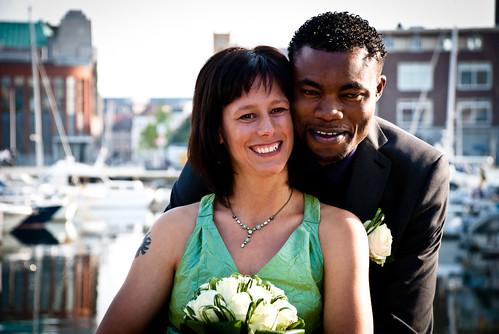
"Black-white marriages are on the rise, a sign that those racial barriers are slowly eroding, but they still lag far behind the rate of mixed-race marriages between whites and other minorities.

"It does suggest that the social distance between the two groups has narrowed," says Zhenchao Qian, a sociology professor at Ohio State University and lead author of a new study on interracial marriages. "The racial boundary is blurred, but it is still there."

The study also found that the share of Hispanic newlyweds who married non-Hispanic whites grew slightly since 1980, but at a slower rate this decade than in previous years.

The share of Asians who married whites dropped. One explanation: Immigration has broadened the pool of potential spouses of the same race and ethnicity. "If the immigration population had not increased, we would have seen more interracial marriages," Qian says.

The study, published in the October edition of the Journal of Marriage and Family, finds that in 2008, 10.7% of blacks who married in the past year married whites, compared with 3% in 1980.

Blacks who have completed higher levels of education are more likely to marry whites because they have a greater chance of interacting with them in school, the workplace and neighborhoods where they live — a fact that has been true for other groups for a while but not for blacks, Qian says.

"This doesn't imply that we've moved into a post-racial society," says Daniel Lichter, director of the Cornell Population Center and study co-author. "Even though there's been a rapid increase (in black-white unions), it's still very low."

Almost 34% of Asians who were recently wed in 2008 married whites, and 28% of Hispanics married whites who are not Hispanic.

"Blacks are still the least assimilated," says Roderick Harrison, a demographer at Howard University and the Joint Center for Political and Economic Studies in Washington. "It does suggest that the divide in this country remains between blacks and everybody else."
To read the complete article please click here.

Wednesday, April 22, 2009

Miss USA, Perez Hilton & Gay Marriage

Ordinarily the Miss USA pageant doesn't drum up much attention. That is, of course, unless one of the contestants says something remarkably unintelligent or highly controversial. This year happened to be one of those years as Miss California, Carrie Prejean, answered a direct question with an honest answer.

Perez Hilton, the well-known celebrity blogger, was one of the celebrity judges and asked Prejean how she felt about the legalization of gay marriage. In a relatively gracious manner, she shared that she felt that marriage should be between a man and woman. Well, that was not the answer that Hilton was looking for and he has gone on the attack since.

The clip below includes Miss California's answer during the pageant's telecast and some remarks from Hilton the day after. Please clip here if the video player doesn't show up.


What I find interesting is that Perez feels that Prejean's belief that marriage should be reserved for a man and woman does not represent all Americans. Well, of course it doesn't! This is a divisive issue that Americans don't agree on. Does he feel that had she answered that she supported gay marriage that it would represent all Americans?! That answer would have "alienated" and "divided" even more Americans. Perhaps it was Hilton who was the one attempting to be alienating and divisive.

Whether Hilton, an openly gay man, wants to admit it or not, there are millions of Americans that hold to the belief that those of the same sex should not be able to get married. And many of us have that belief on the basis of holy Scripture, including Miss California. The reality is that those of us that seek to a life based on the Bible are going to encounter disagreement and persecution. Our worldview often goes against the grain of what is popularly accepted opinion. This should not surprise us nor threaten us.

In fact, Jesus told us that we should expect these kinds of things to happen. Prejean has admirably held to her opinion and remained steadfast to what she said. Hilton, on the other hand, has given a greater indication of his maturity level when he decided to refer to Prejean as a b****. When asked in the clip above if he apologized for that, he held to what he said and gleefully shared that he was actually thinking of calling her an even crasser derogatory word for females. Real classy, Perez.

Just as Carrie Prejean is entitled to her opinion, so is Perez Hilton. I don't have a problem with him holding a belief that contradicts my own. But if he's going to ask a question of someone in a public forum and not be prepared to receive an answer he disagrees with then maybe he should ask himself if he's really the one that is intolerant.

Saturday, January 03, 2009

Rick Warren & the Obama Inauguration

When President-elect Barack Obama selected California pastor Rick Warren to say a prayer at his inauguration, I doubt he realized how much of a response he would get from his liberal base. Even though Warren is generally considered fairly moderate within evangelical circles, those that disagree with his stance on gay marriage have painted him into the same corner as those that are much more in the far right than he is.

Due to the passage of Proposition 8 in California this past November, marriage is to be legally defined as a union between a man and a woman. As one of the most recognizable and vocal supporters of this legislation, Warren has drawn considerable venom from the gay and lesbian community and its supporters. All Obama asked him to do was say a prayer, but his presence at the inauguration seems to represent so much more.

I read a recent interview that Beliefnet.com did with Gene Robinson, the gay Episcopalian bishop from New Hampshire. Robinson is not at all happy that Warren will be on the stage on January 20th and he wants the world to know. Here are some of the thoughts he expressed in the interview:

"I actually have a lot of respect for Rick Warren; amongst evangelicals, he's taken a hit for his compassionate response to AIDS, his commitment to alleviating poverty. He's done some good things. The difficult thing is that he's said, and continues to affirm, some horrendous things about homosexuality -- comparing it to incest, bestiality, that kind of thing. This is not a choice that really represents everyone. This choice was just really, really unfortunate.

I would sit down with Rick Warren this morning if I had the opportunity. I would love to engage him. In some ways he's a very brave person, but he's woefully wrong about the issue of homosexuality. He needs to be confronted about the lies he told about gay people to the people of California.

It's about this particular venue and the role that he has in praying for all of America, and I'm just not sure he'd pray to God the same way I would. I think he is praying to a God, at least around this issue, that calls upon God's homosexual children to deny who they are, to deprive themselves of love and intimacy that is permitted every other one of God's children. He's praying to a God who calls on me, as a gay man, to change, to submit myself to the power of Jesus so I can be healed of this `infirmity' of mine.

The God I know says to me, just like we hear God saying at Jesus' baptism, that you are my beloved, and in you I am well pleased. That's a very, very different God. Imagine the difference between a parent who loves you for you who are, and one that says I'll only love you if you change."
So, there you have it. Robinson does not feel that the selection of Warren to say a prayer at the inauguration does not "represent everyone." Well, who would represent everyone?! Someone that thinks homosexual behavior is ordained by God? The fact is that there is no individual that would represent all of the American population on all issues. And whether Robinson wants to admit it or not, Warren's view that marriage should be reserved as a commitment between and a man and a woman represents the citizens of the U.S. much more than Robinson's perspective. Furthermore, Warren's view (as disagreeable as it may seem to some) actual has a Scriptural basis; Robinson's is based in his feelings.

President-elect Obama is a politically-adept man. His selection of Warren is an expression of his desire to reach out to evangelicals that are at odds with his viewpoint on abortion and gay marriage. He is willing to lose some points with the gay community because he realizes that Christians are a much, much larger voting bloc. Above all else, Obama is a politician. He got elected because he cast himself as one representing a truly diverse country. He ran on the platform of change and that is what he appears to be bringing.

Thursday, November 13, 2008

Standing Up For Marriage

In many circles a major story has been lost in all of the news coverage of the election Barack Obama. In several states (including the one in which I reside, Florida) measures were passed that would legally define marriage as the union between a man and a woman. Surprising to many, this type of measure passed in the state of California. Generally regarded as a left-leaning and progressive state, a number in the gay community did not respond positively to this development.

In fact, protesters have even picketed Mormon temples and Christian churches for their perceived role in the passage of Proposition 8. Conservatives view legally accepted marriages between homosexuals as an assault on a sacred institution, whereas liberals view it as a natural progression in the granting of equal rights to a group of people that have been historically oppressed.

In a pluralistic democratic society, how should we respond when there are proposed changes in the law when it comes to those institutions that we consider sacred, such as marriage? One of the major challenges in the discussion of a sensitive topic such as this is to realize that there are actually at least two different senses in which we view marriage. First, it is a union in the eyes of God "til death do us part." Second, it is a legal contract in the government's eyes that can be broken when seen fit by one or both parties. This is wherein the rub lies. In one sense it is holy, sacred and eternal; in the other it is secular, temporal and limited to this age. Maybe the perspective that C.S. Lewis shared on marriage in his classic Mere Christianity needs to be considered:
"Before leaving the question of divorce, I should like to distinguish two things which are very often confused. The Christian conception of marriage is one: the other is the quite different question — how far Christians, if they are voters or Members of Parliament, ought to try to force their views of marriage on the rest of the community by embodying them in the divorce laws. A great many people seem to think that if you are a Christian yourself you should try to make divorce difficult for every one.

I do not think that. At least I know I should be very angry if the [Muslims] tried to prevent the rest of us from drinking wine. My own view is that the Churches should frankly recognise that the majority of the British people are not Christians and, therefore, cannot be expected to live Christian lives. There ought to be two distinct kinds of marriage: one governed by the State with rules enforced on all citizens, the other governed by the Church with rules enforced by her on her own members. The distinction ought to be quite sharp, so that a man knows which couples are married in a Christian sense and which are not."
Perhaps those that are advocates for gay marriage are so infuriated at those that are against it is because many that claim marriage is sacred and holy treat it as if it is secular and temporal. According to a number of studies, those that identify themselves as born-again Christians divorce at essentially the same rate as the general population. How can we say that marriage is a holy institution that would be threatened by the legalization of gay marriage when an arguably greater threat is the frequency that Christians cheat on their spouses and the alarming rate at which Christians divorce?

In mentioning these realities, I am not attempting to bring greater pain to those that have already suffered the devastating heartbreak of a broken marriage. What I am seeking to do is to cause those of us that call ourselves followers of Jesus to first take a good look at ourselves. There are some in the public eye that are the most vocal critics of gay marriage that have had three or four marriages themselves. And they call it sacred?! When it comes to the marriage debate, the words of Jesus from the Sermon on the Mount resound:
"Do not judge, or you too will be judged. For in the same way you judge others, you will be judged, and with the measure you use, it will be measured to you." "Why do you look at the speck of sawdust in your brother's eye and pay no attention to the plank in your own eye? How can you say to your brother, 'Let me take the speck out of your eye,' when all the time there is a plank in your own eye? You hypocrite, first take the plank out of your own eye, and then you will see clearly to remove the speck from your brother's eye."
For those of us that have not gone through a divorce or physically committed adultery, we don't escape Jesus' warnings either:
"You have heard that it was said, 'Do not commit adultery.' But I tell you that anyone who looks at a woman lustfully has already committed adultery with her in his heart."
Jesus' teachings went beyond what we find comfortable. He spoke against divorce. He spoke against adultery. And, yes, he even spoke against lust. I do think that marriage should not be entered into lightly and I do believe that it should be reserved for a man and woman for life. But I also think it would do us well to consider that our words ring hollow to the mainstream when we claim to be advocates for that which is God-ordained yet continue to not demonstrate that in our own lives.

None of us are perfect and we will all fail from time-to-time so let us remember that our love will always go farther than our anger and that grace has more power to pierce the human heart than judgment.