Friday, November 06, 2015

Why The Bible Is More Than Just Blessings And Promises

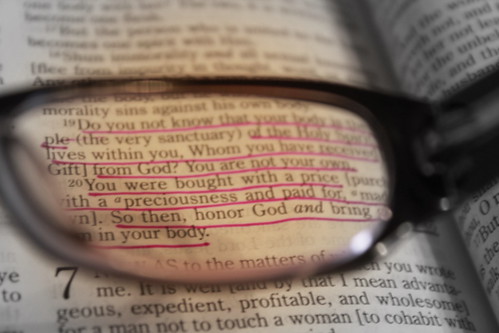
Photo Credit: Chineka
It may be surprising to many modern day Christians but the Bible was not initially written in the manner in which most of us receive it today. Not only was it written in languages that many Americans do not speak (Hebrew, Aramaic and Greek), but it was originally transcribed without the headings and numbered chapters and verses that are now normally found within the Holy Scriptures. Though these elements add convenience for us in locating certain passages of Scripture, this division of God's Word can have unintended consequences.

In his book The Blue Parakeet: Rethinking How You Read the Bible, Scot McKnight comments on the danger that can be found when instead of viewing the Bible in context as we relate to our place in God's grand story, we mainly pull verses out of context simply for our own benefit. McKnight says this:
"Dividing the Bible up into verses turns the Bible into morsels and leads us to read the Bible as a collection of divine morsels, sanctified morsels of truth. We pause for each one to see if we can get something from it. Now I want to meddle with a significant problem. For some morsel readers of the Bible, the Bible has become a collection of morsels of blessings, and we can write one out for each day of the week. Random verses, with generosity poured on top of generosity. On other calendars we get, instead of a blessing, a promise each day. Random verses, with blessing on top of blessing or promise on top of promise. (No one has yet composed a Wrath of God Calendar of Warning, though some seem poised to begin making such a calendar.) 
What happens to the Christian who reads the Bible, day after day and week after week, as little more than a collection of morsels of blessings and promises? For one, everything is good and wonderful and light and airy. These people become optimistic and upbeat and wear big smiles...until something bad happens, until they enter into a period of suffering and feel distant from God, or until they hit a wall. For every hill, there is a valley. 
One of the most important things about the Bible is that it tells realistic truth. Sure, there are kinds of wonderful blessings surrounding Abraham, Moses, David, and Paul...and there are also days of doubt, defeat, disobedience, and darkness. David was on top of the world at times, but he also asked God this question: "My God, my God, why have you forsaken me?" (Psalm 22:1). Edith Humphrey, a New Testament scholar, made this important observation of what happens when we focus solely on blessings and promises: "It is unfortunately the case that some contemporary expressions of Christianity have forgotten, or are embarrassed by, this moment of dark reflection, and instead espouse an unrealistic and warped view of spiritual victory." She also speaks of the "relentlessly upbeat" moods that lead to "false security and canned joy." 
It is important to know the blessings and to rely on God's promises. Please don't misunderstand my point. But the blessings and promises of God in the Bible emerge from a real life's story that also knows that we live in a broken world and some days are tough. The stories of real lives in the Bible know that we are surrounded by hurting people for whom Psalm 22:1 echoes their normal day. 
Those who read the Bible as story refuse to cut up the Bible into morsels of blessings and promises because they know the Story. They know that the David who found God's blessing and trusted in God's promises knew the dark side of life. Imagine how the God of the universe, who chose for some reason to communicate with us in the very thing that makes humans so distinct - sophisticated language in the form of story covering spans of time - must respond as he observes his people seeking random sayings! It's a wonder that God at some point hasn't made the words disappear from the page, so that we open our Bibles up and nothing but blank paper stares us in the face. We deserve it."
Yes, the Bible does contain blessings and promises that can bring encouragement to our days. But it is so much more that. When we "cherry pick" verses to fit our agenda, we do a disservice to the great story that God has given to us through His Word.


Tuesday, September 22, 2015

2015 Demographics for U.S. College Students

Photo Credit: US Dept of Education
The nation's college students are growing in number and our campuses continue to become more diverse. Taken from the most recent edition of The Chronicle of Higher Education Almanac and the Open Doors Report, the following statistics from the 2013-2014 school year contain some interesting facts concerning the current make-up of college students in the United States:

  • There are approximately 21 million college students studying within the United States.
  • Of those 21 million students, more than 4 out of 10 are American ethnic minorities and international students. 
  • Within the state of California alone, there are nearly 2.7 million students. This is an amazing 13% of the country's total! Of these students, over 1.7 million are American ethnic minorities and international students. 
  • Texas has over 1.5 million students in the state, including half a million Hispanic students. 
  • Primarily due to the presence of New York City, 1.3 million students attend college in the state of New York and nearly half of those students are American ethnic minorities and international students.
  • The number of Native American students across the country is approaching 200,000. 
  • Students of Asian American/Pacific Islander heritage now number close to 1.2 million students. 
  • There are 2.7 million African Americans on our campuses, over 13% of all students.
  • Hispanics and Latinos are rapidly growing in number and influence and now comprise well over 14% of all students, totaling over 2.9 million students. 
  • The number of international students currently studying in the U.S. is now over one million. 
  • In demonstration of the country's increasing cultural diversity, half a million of America's college students define themselves as being multi-ethnic.
  • Another 1.2 million students do not self-identify as belonging to any particular ethnic group nor do they define themselves as being multi-ethnic.
  • Students of European descent are still in the overall majority with 10.9 million. If current trends hold true, however, there will be no ethnic majority within the next few years.

What does this all mean? The college campuses of the United States are becoming more diverse, the coasts are rapidly growing and our cities are home to many of the nation's students. In order to reach these students, campus ministries like the one that I work with, Cru, need to adopt new approaches that will effectively reach: 1) students of color; 2) those that speak a primary language other than English; and 3) those in our major cities. The world is here. How will we respond?

Saturday, September 05, 2015

Can One's Religious Beliefs Excuse Them From Their Job?

Photo Credit: King County, WA
What is going on in Kentucky concerning county clerk Kim Davis issuing marriage licenses is an important matter. It is likely, though, that few of us (including me) have a deep understanding of how the law works in these types of cases.

I would suspect that many of us have strong biases in this particular situation and are likely primarily focused on "our side" winning and not necessarily attuned to what the law requires.

A country that values religious freedom as well as the civil rights of all its citizens ensures that cases like this bring with it many questions. This is not a simple matter.

I found this article from Eugene Volokh in The Washington Post to be helpful for me in grasping some of the legal issues related to this case. Things are not "cut and dry" here but Volokh's insights helped me in gaining a greater sense of the issues at play.

Here's a highlight:
"Under Title VII of the federal Civil Rights Act, both public and private employers have a duty to exempt religious employees from generally applicable work rules, so long as this won’t create an “undue hardship,” meaning more than a modest cost, on the employer. If the employees can be accommodated in a way that would let the job still get done without much burden on the employer, coworkers, and customers — for instance by switching the employee’s assignments with another employee or by otherwise slightly changing the job duties — then the employer must accommodate them. (The Muslim flight attendant I mentioned above, for instance, claims that she has always been able to work out arrangements under which the other flight attendant serves the alcohol instead of her.) 
Thus, for instance, in all the cases I mentioned in the numbered list above, the religious objectors got an accommodation, whether in court or as a result of the employer’s settling a lawsuit brought by the EEOC. Likewise, the EEOC is currently litigating a case in which it claims that a trucking company must accommodate a Muslim employee’s religious objections to transporting alcohol, and the court has indeed concluded that the employer had a duty to accommodate such objections. But if the accommodation would have been quite difficult or expensive (beyond the inevitable cost that always come when rearranging tasks), then the employer wouldn’t have had to provide it. 
Now I’m not saying this to praise the law, or to claim that it’s demanded by vital principles of religious principles. One can certainly argue against this approach, especially as applied to private employers, but also as applied to the government. 
The government is barred by the Free Exercise Clause from discriminating based on religion, but the government has no constitutional duty to give religious objectors special exemptions from generally applicable rules. Maybe it (and private employers) shouldn’t have such a statutory duty, either. But my point so far has been simply to describe the American legal rule as it actually is, and as it has been for over 40 years (since the religious accommodation provisions were enacted in the 1972 amendments to Title VII)."
(HT: @spulliam for the article link)