Showing posts with label food. Show all posts

Friday, September 02, 2016

A College Football Player Demonstrates Why Sharing A Meal Makes Such A Difference

Photo Credit: Leah Paske
My family moved a month before I started high school. My mom owned a business and her main office was in a neighboring town so we moved in order to be closer to her work. The change also shaved some time off of my dad's daily commute into Detroit.

Even though we relocated less than 15 minutes away, it felt like I was completely starting over. I was leaving behind the friends I had grown up with and all I had known. Venturing into high school is always a pivotal step in the life of a teen but as an introvert, I was especially anxious about having to make new friends while being "the new kid."

Football practice started a few weeks before classes did so I was starting from scratch with my new teammates and coaches. To make matters worse, my new school was a rival of the high school I would have attended. The guys that were my "enemies" in eighth grade were now my teammates as a ninth grader. My new high school was coming off a state championship and the varsity coach had recently been named the Detroit Free Press "Sports Figure of the Year." To say I was intimidated was an understatement.

All I remember about my first few days of practice is that it felt reminiscent of how my dad had described boot camp with the U.S. Marine Corps. It was physically demanding, I got yelled at a lot and I didn't seem to know what I was doing. Though I was one of the better players on my eighth grade team and distinguished myself as a two-way starter, none of that seemed to matter in a system I was unfamiliar with and to coaches that didn't know me. In fact, it wasn't until the third day of practice that one of my teammates even said a word to me. I felt completely alone and longed to return to my friends "back home."

I eventually made friends and stopped getting yelled at so much. Over time, I became adjusted to my new life and didn't feel quite so alone. But when I recently read the story of Bo Peske (the boy in the photo on the right) and Florida State football player Travis Rudolph (in photo on the left), my mind immediately went back to when I felt so alone as a 14-year-old high school freshman. I remembered how much I simply wanted someone to just be my friend in the way that Travis became to Bo.

It seems that a number of FSU football players were visiting Bo's school when Rudolph noticed Bo sitting alone in the cafeteria. He decided to sit with him and began a conversation over lunch. A worker at the school took a photo and sent it to Bo's mom, Leah. She posted the picture on Facebook, which has now gone viral. Since Bo has autism, he gets treated a bit differently by his classmates and regularly has no one to sit with at lunch.

His mom had this to say after seeing the photo:
"I'm not sure what exactly made this incredibly kind man share a lunch table with my son, but I'm happy to say that it will not soon be forgotten. This is one day I didn't have to worry if my sweet boy ate lunch alone, because he sat across from someone who is a hero in many eyes."
When I think about it, I think most of us are probably a lot like Bo. There are things about us that others may find different that will lead them to not engage with us. And, in many ways, most adults are probably no different than the middle schoolers who choose to not sit with Bo. We might disregard others because of their differences or unintentionally ignore others because we're wrapped up in our own world.

One of the profound things about the example that Travis sets for us is not just that he engages with Bo but he shares a meal with him. The practice of sharing a meal with someone is not to be missed.

When we share a meal with someone, we communicate friendship, identification and acceptance. It is one of the reasons that Jesus was considered so scandalous by the religious leaders of his day. He ate with those considered to be beneath the upper crust of society. But the primary concern of Jesus was not to please self-appointed religious leaders. He was most concerned with glorifying His Father by pouring out His love on people in desperate need of His grace.

The simple act of kindness that Travis Rudolph demonstrated illustrates the difference that selfless love can make in the life of someone else. I wonder how different the world would be if there were more people like Travis. How might it be if we went out of our way to care for those that we perceive to be different and seek to get to know them in a personal way? What if, like Jesus, we took the time to share a meal with those who might be different than us?

Wednesday, September 24, 2014

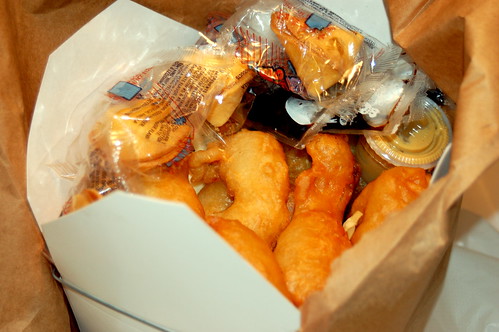
How Authentic Is American Chinese Food?

Photo Credit: yorkd
From Mental Floss:
"If you showed one of these iconic white pails to people in China, they might scratch their heads. The little boxes were patented on November 13, 1894 in Chicago by the not-so-Chinese inventor Frederick Weeks Wilcox (who wanted to improve the wooden oyster pails commonly used to transport raw mollusks from fish markets). They’re distinctly American—as is the takeout packed inside them. 
Chinese restaurants first started popping up in America in the mid-1800s when immigrants—mostly from present-day Guangzhou—flocked to California during the Gold Rush. The eateries spread, and by the 1920s, Chinese restaurants were featuring two menus: one with traditional fare; the other an Americanized version. The latter menu, which featured foods doused in sweet, salty, syrupy sauces, became a cuisine all its own. 
For example, the broccoli, tomatoes, carrots, and yellow onions found at American Chinese restaurants aren’t part of traditional Chinese cooking. (Tomatoes and broccoli aren’t even native to China!) That General Tso’s chicken you adore? American. Those fortune cookies? Not just American, but based on Japanese crackers. Chinese food is so ingrained in American culture that there are more Chinese restaurants in the U.S. than there are McDonald’s."
What we view as culturally authentic may really not be when distinctiveness is sacrificed in order to gain mass appeal.

Saturday, August 31, 2013

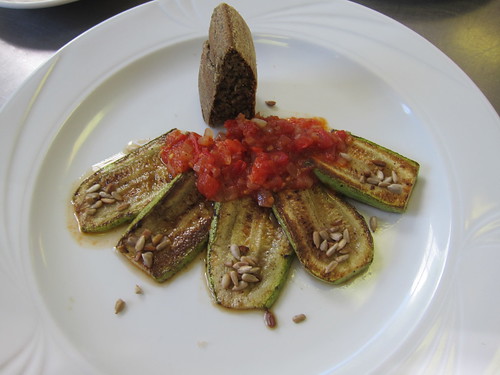
A Movement To Rediscover Native American Cuisine

Photo Credit: U.S. Embassy Kyiv Ukraine
Newsweek's Paul Wachter writes about Apache-Navajo chef Nephi Craig and his mission to introduce traditional Native American cuisine to a broader audience. He writes:
"Nephi Craig graduated from culinary school in 2000 and began a promising career. In a few years, he was working his way up the stations at Mary Elaine’s, Arizona’s only five-star French restaurant, led by James Beard Award–winning chef Bradford Thompson. “I was getting a great French, classical training, but something was missing,” says Craig, who is 33. “The French tradition isn’t my tradition, and I wanted to cook in the tradition of my people: Apaches and Navajos.” 
It’s an early Tuesday morning in late July, and Craig is driving his 10-year-old son, Ari, and me around the Fort Apache Indian Reservation, which is nestled in the White Mountains of eastern Arizona. Craig, whose mother is Apache and whose late father was Navajo, likes punk rock and skateboarding and is quick to laugh. Though he was born in Whiteriver (the reservation’s largest community) and spent most of his youth there—he also lived for several years on a Navajo reservation—he never thought he’d spend his adulthood here. He went to culinary school in Scottsdale and then spent three years cooking at an affluent country club in the northern part of the city before joining Mary Elaine’s. 
“The French tradition isn’t my tradition,” he says, “and I wanted to cook in the tradition of my people: Apaches and Navajos. At Mary Elaine’s, we’d use a lot of local ingredients—rabbit, venison, squash, and corn—that I recognized as part of indigenous culinary history but were prepared in the French style,” he says. “And as I got better as a chef, I began to think about using my skills to showcase my own peoples’ culinary ways.” 
But he had a lot of learning to do. “Even growing up on the reservation, I got the same two-page social-studies version of our indigenous history,” he says. “You know, the pilgrims and stuff.” After leaving Mary Elaine’s, he began to devote himself to rediscovering indigenous food. He traveled widely, hosting private dinners and conferences, and seeking out other Native American chefs as well as academics who had researched the cuisine of his ancestors. And when, in 2009, he learned of an opening at the White Mountain Apache Tribe’s Sunrise Park Resort, “it was,” he says, “the right time to bring my ideas back home.” 
Craig was eventually appointed executive chef at the resort. His restaurant serves mostly standard American fare. But guests can also book seats at his chef’s table—and it’s there, as well as through a group he founded called the Native American Culinary Association, that Craig is acting on his dream: to restore and reinvent the largely forgotten cuisine of his forebearers.
A Search on the Zagat website for New York City lists 554 Italian restaurants, 191 French establishments, and 179 Japanese restaurants. There are 10 Ethiopian restaurants. But there isn’t a single Native American restaurant listed. There’s no culinary nod to the Lenape Indians who inhabited Manhattan long before Daniel Boulud and Mario Batali. 
“American dining is based on our immigrant population, not our Native population,” says Lois Ellen Frank, a half–Kiowa Indian chef-scholar who wrote Foods of the Southwest Indian Nations. Ask an American today for his or her conception of Native American cuisine, and you’ll likely be met with some mumbling about Thanksgiving. 
Before the Colonial era, Apaches relied for food on a “triptych of hunting, gathering, and raiding,” explained Thomas Mails in The People Called Apache. Mails was writing specifically about the Mescalero Apaches of New Mexico, Texas, and Mexico, but the same can be said of White Mountain Apaches. Acorns, seeds, and nuts were staple foods in their largely plant-based diet, which also included rabbits, birds, raccoons, fish, and other native animals. Food was local. 
“If you lived in the Pacific Northwest, you would know the six types of salmon and know how to harvest them, but if you were a Navajo Indian on the Midwestern plains, you never would have seen one,” Frank says. Early European contact and trade introduced new foods, which many Native American chefs today also consider part of their peoples’ authentic culinary tradition. “It’s fair to talk about Navajo sheep even though sheep were imported to the Americas, just as we now consider the tomato to be an authentic and indispensable part of Italian cuisine even though it came from Mexico,” Frank says.
To read the rest of the article please click here.

Monday, February 07, 2011

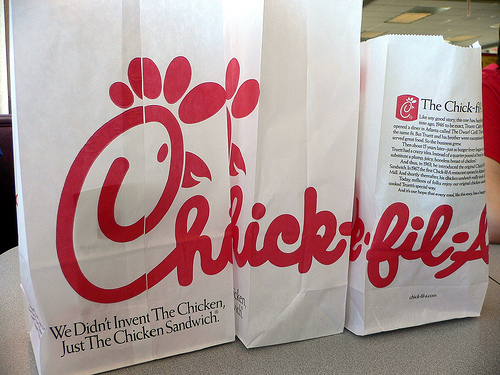
Is it Time for Chick-fil-A to Abandon its Christian Identity?

Photo Credit: Link576
Chick-fil-A, the fast food restaurant popular in the southern United States, is currently facing something it is not used to -- controversy. After donating some free food to an organization that is against gay marriage, a number of gay rights groups have publicly condemned the company.  The Atlanta Journal Constitution weighs in on the story:
"We're not anti-anybody," said [Dan] Cathy, son of the company's founder, Truett Cathy. "Our mission is to create raving fans."

Earlier this month, Cathy appeared on a Facebook video to argue that the Chick-fil-A sandwiches and brownies to be provided at a marriage-training event sponsored by the Pennsylvania Family Institute are not an endorsement of the group's politics.

On Saturday, Cathy issued a statement saying that "While my family and I believe in the Biblical definition of marriage, we love and respect anyone who disagrees." Cathy said Chick-fil-A would not champion any political agendas on marriage and family. That is not a change from previous practice, Cathy said -- "just a confirmation."

"We've opted not to get involved in the political debate," he told the AJC. "It's never been our agenda."

But Chick-fil-A finds itself squarely in the political debate. A New York Times story published Sunday noted the conservative religion that is built into Chick-fil-A's corporate ethos have run it against the gay rights movement. Students at some universities have tried to get the chain removed from campuses.

Recently, administrators at the Indiana University South Bend suspended weekly Wednesday sales of Chick-fil-A items at two main dining areas, according to the South Bend Tribune. The administration wanted to review complaints raised by a student group and members of the executive committee of the Academic Senate.

Cathy says Chick-fil-A operates its business on Biblical principles but "is not a Christian company." It's a nuanced distinction, and many customers may miss it."
Chick-fil-A is a unique business. In respect for the Judeo-Christian tradition of Sabbath rest, they are the rare business that closes operations on Sundays so that their employees and customers have the day for focused time with family or to spend time at the house of worship of their choice.  They often play Christian music in their stores and the toys contained within their kids meals often are educational in nature, with a strong moral message.

But the reasons I go to my local Chick-fil-A are not simply because of the Christian foundations that the company was founded on.  I like Chick-fil-A because they have great chicken sandwiches, I can take my children to their play place, their restaurants offer free Wi-Fi, they have free newspapers available and their customer service is unparalleled in the fast food service industry. (For example, when I ask for a refill on my Diet Coke, the response is always, "It would be my pleasure.")

As a Christian, I seek to support businesses that reflect my values and the values that I wish to instill in my children.  I choose not to support companies that promote other value systems that I don't agree with.  And make no mistake about it. Every business promotes some kind of values.  The question is which values does it support and will I support those values with my dollar?

Unlike some of my fellow Christian brothers and sisters, I do not have a problem with gay rights groups boycotting or discouraging others from buying their food at Chick-fil-A.  I happen to disagree with them but I support their right in an American society to do so.  As some of the leaders when it comes to boycotts and organizing campaigns against companies that send a message contrary to what we think is appropriate, Christians should not be surprised when others do the same. If they feel like a business is actively treating them unfairly, they should boycott them.

To my understanding, though, Chick-fil-A does not discriminate against gay and lesbian customers or have some sort of policy against gay employees (which I would not support).  They simply gave some food to a local organization that was holding a local event (as do many restaurants throughout the country). For sure, if Chick-fil-A was in the business of selling Jesus they would have had to shut their doors a long time ago since there is no Jesus combo meal on the menu.  But, as it is, they're in the business of selling chicken sandwiches and they do a wonderful job.

I, for one, hope that Chick-Fil-A continues to do what it does. I hope that they continue to support a variety of local charities, whether those organizations are Christian in nature or not. In addition, their continued refusal to be open on Sundays defies conventional wisdom yet they've still been able to run a profitable business by being open just six days out of the week.  Their "Closed on Sundays" policy declares that there are more important things than just making money and that is something that is worth supporting.

If none of that convinces you to support Chick-fil-A, perhaps Tim Hawkins will.  Please click here if the video player does not show up.

Saturday, November 07, 2009

What's Your Favorite Hot Dog?

I took a trip this past week to spend a couple days with our Impact staff in Indianapolis. On the flight up, I found my self engrossed in a magazine article about a writer's experience sampling hot dogs throughout Chicago in order to find the Windy City's best dog. Even though I've been to Chicago a number of times, I've never actually had what is called a "Chicago-style" hot dog -- a dog topped with mustard, onions, sweet pickle relish, a dill pickle spear, tomato slices, peppers, celery salt and poppy seed bun.

As a native Michigander, I am most familiar with the Coney Island hot dog -- a dog with a steamed bun and topped with a beanless chili sauce, mustard, and chopped onions. Coney Islands are very popular in the Detroit area and my favorite location is the one downtown of my hometown, Port Huron. I have to visit Coney Island whenever I get back home! Anybody can have the standard hot dog with ketchup and mustard but I like mine to have more than the everyday toppings.

After living in the southern part of the U.S. for several years, I have been introduced to another version of the hot dog, the Carolina slaw dog. This is simply a hot dog that is topped with a creamy cole slaw. I've heard that the slaw dog can also contain chili and/or mustard with it, but I've only had it with just the cole slaw and it is tasty.

Back to the Chicago-style dog... After wrapping up my time in Indy, I arrived to the airport and walked to my gate. I only had about forty minutes before boarding my flight but I hadn't had dinner yet so I was looking for something quick to get. And, wouldn't you know it, right by gate was a hot dog joint specializing in Chicago-style dogs! I ordered one and loved it. It wasn't able to top Coney Island in my book, but it definitely was good.

I'm interested to know, what is your favorite style of hot dog? In your opinion, which restaurant serves the best?