Showing posts with label mascots. Show all posts

Saturday, August 27, 2016

Weekly Web Roundup (8/27/16)

Photo Credit: chefmaggio
Here are some interesting stories from around the web that I've seen during this past week:

Like Families and Soccer Teams: Church and Parachurch by Brian Strider (The Gospel Coalition)
"Working for a parachurch ministry, on the other hand, is more like playing for a soccer team. Team members are selected, and then they gather to play soccer. They don't gather to receive math tutoring, to brush their teeth, or to care for the elderly. They gather for one purpose and for a limited season: to play soccer. But a family is different. It's broader and deeper. Whether you're adopted or born into one, your family is responsible for your entire nurture, growth, and education. Your family is the group of people you live with and learn to love. The relationships are permanent and all-defining. Though you might be disappointed if your soccer league dissolved, you'd be devastated if your family disappeared."
Wind during river fest sends 1,500 floaters to Canada by Nicole Hayden (USA Today)

My hometown of Port Huron, Michigan made the national news this past week when a large number of people floating on the St. Clair River ended up on the Canadian side of the US/Canada border. Here's the story of what happened.

American Students Are Still Segregated by Income, Race by Kenrya Rankin (Colorlines)
"Fully half of American children live in high-poverty school districts—where more than 75 percent of students quality for free or reduced-price lunch—which leaves them more vulnerable to health crises, violence and subpar facilities. Frequently, these impoverished districts border affluent areas where students are bolstered by the funding that comes from higher property taxes. For “Fault Lines: America’s Most Segregating School District Borders,” researchers analyzed 33,500 individual school district boundaries to see just how economically segregated districts are."
The real history of Native American team names by Erik Brady (USA Today)
"Most damning, Native American children were often taken from their families and sent to boarding schools under an assimilation policy that amounted to cultural genocide. Its motto: “Kill the Indian and save the man.” Students were told not to speak their languages, even to each other. Their long hair was cut short. They were taught reading, writing, arithmetic and — in a form of state-sponsored religion — Christianity. “All of this was taking place outside the view of the average American,” Gover says. “At that time, someone living in Philadelphia — or, more tellingly, in Cleveland or Boston — might conclude there are no Indians anymore. They are gone. And, in fact, that was the objective of federal policy. … So there were a lot of very powerful forces at work to deny Native American people of agency over their own identities and their very lives. And that’s when the mascots emerged.”"
Orlando Health, Florida Hospital won't bill Pulse shooting victims by Kate Santich and Christal Hayes (Orlando Sentinel)

The city of Orlando experienced a horrific tragedy earlier this summer when 49 people were murdered by a gunman at the Pulse nightclub. Since then there have been countless examples of people that have cared for and reached out to the victims, as well their families. Now, millions of dollars in hospitals bills will be forgiven. Bravo to Orlando Health and Florida Hospital.

MTV Decoded Answers The Question ‘Are Hispanic People White?’

Many people are confused about who is considered to be Hispanic or Latino and why these terms are not necessarily interchangeable. In this video, Franchesca Ramsey and Kat Lazo of MTV News 'Decoded' series explain how to understand the racial and ethnic identity of Hispanics and Latinos.

Monday, August 15, 2011

Should We Use Native American Sports Mascots?

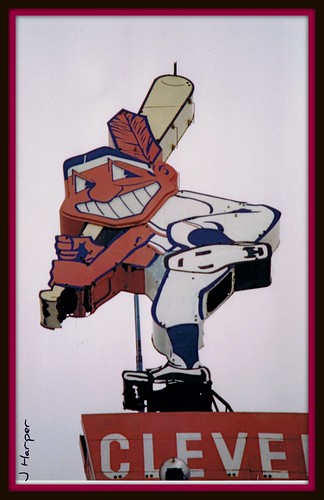
Photo Credit: BGSU86
I want you to take a good look at the image to the left. What comes to your mind when you look at that? If you're from Cleveland, it may remind you of a baseball team that you follow. But if you are of Native American descent, this image likely doesn't bring up pleasant feelings.

There has been a lot of discussion in recent years about the use of Native images in American sports, whether at the professional, collegiate, high school or other levels. If you're like most people, you probably haven't given much thought to it. You've grown up in a society that generally accepts the use of the term Redskins for an NFL team and Atlanta Brave fans doing the "tomahawk chop" at games. So is the move to ban Native American sports mascots just another attempt at political correctness or is it something more than that?

One university, the University of North Dakota, looks to be currently in the final stages of a process to change their name. CNN.com reports:
"The University of North Dakota is one step closer to retiring its nickname and mascot, but changing the school's 90-year-old Native American moniker -- the Fighting Sioux -- has not been without complications.
The school faces a Monday deadline to comply with the NCAA's policy on mascots "deemed hostile or abusive toward Native Americans."
School officials were in the process of coming up with a new name and mascot this year until North Dakota legislators passed a law ordering them to stop, according to UND spokesman Peter Johnson.
The rock and the hard place the school finds itself between marks the last gasp of a decades-long fight not just in North Dakota, but in all of college sports -- the climax (or nadir, depending on some people's perspective) of a nostalgia-imbued resistance to political correctness on the playing field."
I am generally opposed to the use of Native images and mascots for sports teams. These names and images have typically been born out of the tragic history of this nation and continue to perpetuate stereotypes and remind the First Nations people of this land of their mistreatment over the centuries. The argument is often made that the use of these names and images honor the original inhabitants of what is now known as the United States. Sadly, when white people put on "war paint", wear ceremonial headdresses, and do chants at sporting events without any knowledge or appreciation of the culture that these things come from, it comes off as much more of a mocking of that culture than anything honorable.

Although I do believe that in rare cases this is possible (I'll get to that in a minute), there are likely other ways that would serve to honor American Indians more than the caricatures that are often connected to our sports teams. Barbara Munson, of the Oneida Nation, offers some other suggestions:
Indian people do not pay tribute to one another by the use of logos, portraits or statues.
The following are some ways that we exhibit honor:
1. In most cultures to receive an eagle feather is a great honor, and often such a feather also carries great responsibility.
2. An honor song at a Pow-Wow or other ceremony is a way of honoring a person or a group.
3. We honor our elders and leaders by asking them to share knowledge and experience with us or to lead us in prayer. We defer to elders. They go first in many ways in our cultures.
4. We honor our young by not doing things to them that would keep them from becoming who and what they are intended to be.
5. We honor one another by listening and not interrupting.
6. We honor those we love by giving them our time and attention.
7. Sometimes we honor people through gentle joking.
8. We honor others by giving to them freely what they need or what belongs to them already because they love it more or could use it better than we do.
I understand that sports hold a special place in American culture. We are committed to our teams and our loyalty runs deep. We have years worth of paraphernalia connected to our teams and are hesitant to make changes to the names and images of the teams we love. Having grown up in the state of Michigan, I am well familiar with the influence that Native culture has had on current American society. The use of Native names is very common within the state and my college alma mater, Central Michigan University, is known as the Chippewas, a Native tribe that is one of the largest First Nations people groups within North America.

But I am supportive of the use of the Chippewas moniker for CMU. Does this make me a hypocrite? Well, not necessarily. Although I am generally in disagreement of the use of Native names and images in connection with sports teams, CMU is a bit of a unique situation. When I was a student there in the early nineties the university was in the midst of a major review of whether they would keep the Chippewa name or not. It was during a time when other major schools nearby (e.g. Miami (Ohio), Eastern Michigan, etc.) were changing their names and it appeared that Central would follow suit.

But at the end of this review it was decided to keep the name. Why? Because in this case, there is a Chippewa tribal reservation just minutes from the university and CMU and the tribe have a strong relationship. In this instance, the tribe felt that the school did honor their people with the use of that name since 1) It was not a derogatory name (e.g. Redskins) and 2) The school agreed to do away with all Native imagery in connection with their athletic teams.

Because of the tribal approval that is given to the university, CMU was one of the few exceptions that the NCAA gave a few years ago when it banned the use of Native names for its members. Although this issue continues to be discussed, it is still an accepted part of the university. As a student, I was enriched by the Chippewa culture that was part of the university life and took advantage of the opportunity to learn about a culture other than my own.

I'm thankful that I am an alum of an institution that is one of the few cases that actually honors First Nations people in connection with their athletic teams. In other cases, I would like to challenge you to stop supporting institutions that continue to encourage the use of negative stereotypes and images in connection with their teams. It is not a matter of political correctness... it's a matter of doing the right thing.