Monday, February 07, 2011

Is it Time for Chick-fil-A to Abandon its Christian Identity?

Photo Credit: Link576
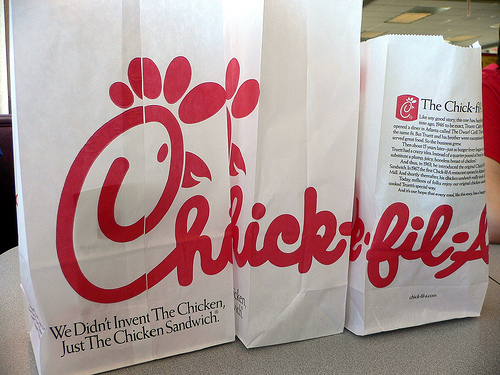
Chick-fil-A, the fast food restaurant popular in the southern United States, is currently facing something it is not used to -- controversy. After donating some free food to an organization that is against gay marriage, a number of gay rights groups have publicly condemned the company.  The Atlanta Journal Constitution weighs in on the story:
"We're not anti-anybody," said [Dan] Cathy, son of the company's founder, Truett Cathy. "Our mission is to create raving fans."

Earlier this month, Cathy appeared on a Facebook video to argue that the Chick-fil-A sandwiches and brownies to be provided at a marriage-training event sponsored by the Pennsylvania Family Institute are not an endorsement of the group's politics.

On Saturday, Cathy issued a statement saying that "While my family and I believe in the Biblical definition of marriage, we love and respect anyone who disagrees." Cathy said Chick-fil-A would not champion any political agendas on marriage and family. That is not a change from previous practice, Cathy said -- "just a confirmation."

"We've opted not to get involved in the political debate," he told the AJC. "It's never been our agenda."

But Chick-fil-A finds itself squarely in the political debate. A New York Times story published Sunday noted the conservative religion that is built into Chick-fil-A's corporate ethos have run it against the gay rights movement. Students at some universities have tried to get the chain removed from campuses.

Recently, administrators at the Indiana University South Bend suspended weekly Wednesday sales of Chick-fil-A items at two main dining areas, according to the South Bend Tribune. The administration wanted to review complaints raised by a student group and members of the executive committee of the Academic Senate.

Cathy says Chick-fil-A operates its business on Biblical principles but "is not a Christian company." It's a nuanced distinction, and many customers may miss it."
Chick-fil-A is a unique business. In respect for the Judeo-Christian tradition of Sabbath rest, they are the rare business that closes operations on Sundays so that their employees and customers have the day for focused time with family or to spend time at the house of worship of their choice.  They often play Christian music in their stores and the toys contained within their kids meals often are educational in nature, with a strong moral message.

But the reasons I go to my local Chick-fil-A are not simply because of the Christian foundations that the company was founded on.  I like Chick-fil-A because they have great chicken sandwiches, I can take my children to their play place, their restaurants offer free Wi-Fi, they have free newspapers available and their customer service is unparalleled in the fast food service industry. (For example, when I ask for a refill on my Diet Coke, the response is always, "It would be my pleasure.")

As a Christian, I seek to support businesses that reflect my values and the values that I wish to instill in my children.  I choose not to support companies that promote other value systems that I don't agree with.  And make no mistake about it. Every business promotes some kind of values.  The question is which values does it support and will I support those values with my dollar?

Unlike some of my fellow Christian brothers and sisters, I do not have a problem with gay rights groups boycotting or discouraging others from buying their food at Chick-fil-A.  I happen to disagree with them but I support their right in an American society to do so.  As some of the leaders when it comes to boycotts and organizing campaigns against companies that send a message contrary to what we think is appropriate, Christians should not be surprised when others do the same. If they feel like a business is actively treating them unfairly, they should boycott them.

To my understanding, though, Chick-fil-A does not discriminate against gay and lesbian customers or have some sort of policy against gay employees (which I would not support).  They simply gave some food to a local organization that was holding a local event (as do many restaurants throughout the country). For sure, if Chick-fil-A was in the business of selling Jesus they would have had to shut their doors a long time ago since there is no Jesus combo meal on the menu.  But, as it is, they're in the business of selling chicken sandwiches and they do a wonderful job.

I, for one, hope that Chick-Fil-A continues to do what it does. I hope that they continue to support a variety of local charities, whether those organizations are Christian in nature or not. In addition, their continued refusal to be open on Sundays defies conventional wisdom yet they've still been able to run a profitable business by being open just six days out of the week.  Their "Closed on Sundays" policy declares that there are more important things than just making money and that is something that is worth supporting.

If none of that convinces you to support Chick-fil-A, perhaps Tim Hawkins will.  Please click here if the video player does not show up.

Friday, February 04, 2011

Census Shows Ethnic Minorities on the Rise

Photo Credit: Office of Governor Patrick
According to initial figures from the recent U.S. census, the number of American ethnic minorities continues to rise. These population gains will add to the political clout for ethnic groups, most especially Hispanics, currently underrepresented in government.

From MSNBC.com:
"U.S. racial minorities accounted for roughly 85 percent of the nation's population growth over the last decade — one of the largest shares ever — with Hispanics accounting for much of the gain in many of the states picking up new House seats.

Preliminary census estimates also suggest the number of multiracial Americans jumped roughly 20 percent since 2000, to over 5 million.

The findings, based on fresh government survey data, offer a glimpse into 2010 census results that are being released on a state-by-state basis beginning this week. New Jersey, Mississippi, Virginia and Louisiana are the first to receive the census redistricting data, which will be used in the often contentious process of redrawing political districts based on population and racial makeup.

Four of the eight states gaining House seats owe roughly half or more of their population gains over the last decade to Hispanics. They include Texas, which picks up four seats; Florida, which will add two seats; and Arizona and Nevada, picking up one seat apiece.

In Georgia and Washington state, which also gain one seat each, Hispanics combined with other minority groups accounted for a majority of their growth since 2000.

Among states losing House seats, Louisiana and New Jersey each would have posted a net population loss, and Michigan would have sustained bigger declines, if it hadn't been for Hispanic growth. Latinos also made up roughly 60 percent or more of the growth in New York, Pennsylvania, Ohio, Illinois, Iowa and Massachusetts — which each lose a seat — raising questions as to whether remaining districts in those states will need to accommodate emerging Hispanic voting blocs.

Broken down by voting age, minorities accounted for roughly 70 percent of U.S. growth in the 18-and-older population since 2000, and Hispanics made up about 40 percent. Hispanics also represented more than half the growth share of the voting-age population in Texas and California.

"The growth of the Hispanic community is one of the stories that will be written from the 2010 census," Census director Robert Groves said Wednesday, previewing major demographic trends, including the movement of many minorities from city to suburb. "We should see a big difference from 2000 to 2010."

The preliminary demographic numbers are based on the Census Bureau's Current Population Survey as of March 2010, as well as comparisons of the 2000 census with 2009 demographic estimates and the 2009 American Community Survey, which samples 3 million U.S. households. According to those figures, minorities represented between 81 percent and 89 percent of the U.S. population growth since 2000, higher than the official 80 percent share in 2000.

The minority growth share in 2010 is the largest in recent memory, with only the influx of European minority immigrants such as Italians, Poles and Jews in the late 1800s possibly rivaling it in scope, said William H. Frey, a demographer at Brookings Institution who analyzed the census data."
To read the rest of the article click here.

(h/t to TheRoot.com)

Tuesday, February 01, 2011

What Americans Give to Churches, Charities & Foreign Missions

Photo Credit: borman818
Here are some interesting statistics from Christianity Today regarding giving patterns of Americans as it pertains to charities, foreign missions and churches:
"Churches and other explicitly religious organizations are by far the largest recipients of Americans' charitable donations. But church members' giving is decreasing in the recession, especially as a percentage of income. The amount of church-based giving that goes to missions is also decreasing significantly. From 1916-1927, about 7.9% of church contributions went to foreign missions; today it's 2.1%. (From Empty Tomb, Inc.)

Total charitable giving in the U.S. (unadjusted for population or income) dropped by about 3.6% in 2009, though individual giving stayed steady from 2008. (From Giving USA)"

Tithing
  • 1968 - The average percentage of income given to churches was 3.11%
  • 1985 - The average percentage of income given to churches was 2.59%
  • 2008 - The average percentage of income given to churches was 2.43%
Overseas Missions Giving
How much of each selected denomination's church dollar goes to international ministries? (From Empty Tomb, Inc.)
  • 11 cents - Christian Missionary & Alliance
  • 6 cents - Church of the Nazarene; General Association of General Baptists
  • 4 cents - Seventh Day Adventists - North America; The Wesleyan Church, The Presbyterian Church in America
  • 2 cents - Southern Baptist Convention; The United Methodist Church
  • 1 cent - Lutheran Church - Missouri Synod; Christian Church (Disciples of Christ); Evangelical Lutheran Church in America; Presbyterian Church (USA); The Episcopal Church
Beyond Church Giving
Americans gave 303.75 billion in 2009. Three quarters of it came from individuals. Here's where the money went (From The Chronicle of Philanthropy):
  • Religion (33%)
  • Education (13%)
  • Gifts to Grant Making Foundations (10%)
  • Unallocated Giving (10%)
  • Human Services (9%)
  • Public-Society Benefit (8%)
  • Health (7%)
  • Arts, Culture & Humanities (4%)
  • International Affairs (3%)
  • Environment/Animals (2%)
  • Foundation Grants to Individuals (1%)
As these numbers can attest, Americans give billions each year to their local churches, favorite charities and other worthy causes. However, the richer we have become as a nation, we've given a smaller percentage of our income to that which has eternal significance.  Perhaps an appropriate question to ask ourselves is not how much we give but how much do we keep?